
Table of Contents
India’s Biological Regulatory Ecosystem Explained: CDSCO, RCGM, GEAC, DBT, NIB & Beyond


Why India’s Regulatory System is Different
For companies entering India with Biological products for the first time, one of the most frequent surprises is the multiplicity of Regulatory authorities involved in approval, oversight, and commercialisation. Unlike the US FDA — a single agency with comprehensive jurisdiction over Biologics — India’s Biological Regulatory system involves at least five distinct authorities, each with its own mandate, review processes, and statutory basis.
This architecture is not bureaucratic complexity for its own sake. It reflects India’s specific context: a country that is simultaneously a global leader in generic Pharmaceuticals, a rapidly growing Biologics manufacturer, a major vaccine producer for the developing world, and a nation with legitimate concerns about biosafety, environmental risk, and genetic modification. Each authority in the system addresses a distinct dimension of these concerns.
Understanding this ecosystem is not merely an academic exercise. Companies that fail to engage all relevant authorities at the right time routinely experience approval delays of 12 to 24 months that could have been avoided with better Regulatory planning.
The Primary Authorities and Their Roles
CDSCO — Central Drugs Standard Control Organisation
CDSCO, under the Ministry of Health and Family Welfare, is the primary Regulatory authority for all Drugs and Biologics in India, including approval of clinical trials and marketing authorisations. The Drug Controller General of India (DCGI) heads CDSCO and has the statutory authority to grant or refuse approval for Biological products under the Drugs and Cosmetics Act, 1940 and Rules thereunder.
For most Biological products, CDSCO is the anchor of the Regulatory process. All applications for marketing authorisation (Form CT-18 or Form CT-21 under New Drug and Clinical Trial Rules, 2019) are submitted to CDSCO. The Scientific Expert Committee (SEC) — convened by CDSCO — reviews complex biological applications and provides recommendations to the DCGI.
CDSCO also oversees post-market Pharmacovigilance through the Pharmacovigilance Programme of India (PvPI) and has recently strengthened its biological-specific vigilance requirements through the Biologicals-specific adverse event reporting framework.
RCGM — Review Committee on Genetic Manipulation
RCGM operates under the Department of Biotechnology (DBT) and has statutory authority under the Environment Protection Act, 1986, and the Rules for the Manufacture, Use, Import, Export and Storage of Hazardous Microorganisms / Genetically Engineered Organisms or Cells, 1989 (commonly called the EPA Rules or Recombinant DNA Rules).
RCGM’s mandate covers all activities involving genetically modified organisms, recombinant DNA technology, and contained use of genetically modified cells or microorganisms. Practically, RCGM approval is required for:
- Manufacturing of recombinant Biologics (including biosimilars, mAbs, and gene therapy vectors) in India
- Import and clinical use of genetically modified cell therapy products (including CAR-T therapies)
- Research activities involving genetic manipulation at Indian institutions
For companies manufacturing recombinant Biologics in India, RCGM issues approval for the manufacturing facility as a contained use establishment. For importers of recombinant products, RCGM is typically less directly involved in the Import pathway, but may be engaged for novel gene therapy or cell therapy products.
GEAC — Genetic Engineering Appraisal Committee
GEAC, also under the Ministry of Environment, Forest and Climate Change, deals with the environmental release of genetically modified organisms — its mandate is more relevant to agricultural GMOs and large-scale environmental use than to most Pharmaceutical Biologics. However, GEAC may have relevance for:
- In vivo gene therapy products that could potentially result in germline modification (a highly scrutinised category globally)
- Large-scale manufacturing activities with GMOs that could present environmental risk if containment fails
For most Biosimilars, mAbs, and standard recombinant proteins, GEAC involvement is not required. However, for novel gene therapy programmes — particularly those involving viral vector administration in vivo — Regulatory counsel should confirm the scope of GEAC engagement required.
DBT — Department of Biotechnology
DBT sets India’s national biotechnology policy and administers both RCGM and several major funding programmes for Indian biotech companies. For foreign manufacturers, DBT’s direct Regulatory role is limited, but the department’s policy positions on technology transfer, Biosimilar development incentives, and Advanced Therapy regulation shape the broader Regulatory environment.
DBT is also the sponsoring ministry for several important institutions that global biologics companies will encounter, including the Centre for Cellular and Molecular Biology (CCMB) and the National Institute of Immunology (NII), which may be involved in academic collaborations or expert committee evaluations.
NIB, Noida/ CDL, Kasauli — National Institute of Biologicals / Central Drugs Laboratory
The National Institute of Biologicals (NIB) and the Central Drugs Laboratory (CDL) at Kasauli, Himachal Pradesh, play a critical role in the lot release and quality testing of specific Biological products in India. Mandatory pre-market lot testing at NIB/CDL is required for:
- Vaccines (both domestic and imported)
- Blood and blood products
- Certain sera and toxoids
For companies in these product categories, understanding NIB’s testing protocols, sample requirements, and timelines is essential for commercial planning. Batch release at NIB can add four to twelve weeks to the time between manufacturing and commercial release, and companies must factor this into their supply chain planning.
State Drug Regulatory Authorities
India’s federal structure means that state Drug Regulatory authorities also play a role, particularly in:
- Licensing of manufacturing facilities for Biologics produced in India
- Wholesale dealer licensing for commercial distribution
- State-level inspection and enforcement activities
States with significant Pharmaceutical manufacturing activity — Maharashtra, Gujarat, Himachal Pradesh, Telangana, and Karnataka — have robust state Drug Regulatory infrastructure. Companies establishing manufacturing operations in India must engage with state authorities in parallel with central CDSCO processes.
Common Mistakes Made by Overseas Manufacturers
Based on CliniExperts’ experience guiding global Biologics companies through India market entry, the most common regulatory mistakes fall into four categories:
1. Treating India as a Single-Window Process
Companies accustomed to single-agency Regulatory systems (FDA, EMA) often file their CDSCO application and assume the Regulatory process is complete. Discovering mid-review that RCGM approval is also required — or that NIB batch release will add months to commercial launch — creates costly delays.
2. Underestimating IBSC and Site Readiness for Advanced Therapies
For cell and gene therapy developers, the absence of functional IBSCs at intended Clinical sites is a particularly acute problem. Site selection must account for biosafety infrastructure, not just clinical expertise.
3. Ignoring the Regulatory Intelligence Landscape
India’s Biological Regulatory framework is actively evolving. Guidance documents, draft guidelines, and policy circulars issued by CDSCO, DBT, and RCGM can significantly affect submission requirements — often with short notice. Companies that rely on outdated information or infrequent regulatory monitoring are frequently caught off-guard.
4. Inadequate Coordination Between Local and Global Teams
Many global companies assign India regulatory activities entirely to local teams without adequate integration with global Regulatory strategy. India requires India-specific adaptations to dossiers, study designs, and commercialisation plans that cannot be effectively managed purely from headquarters.
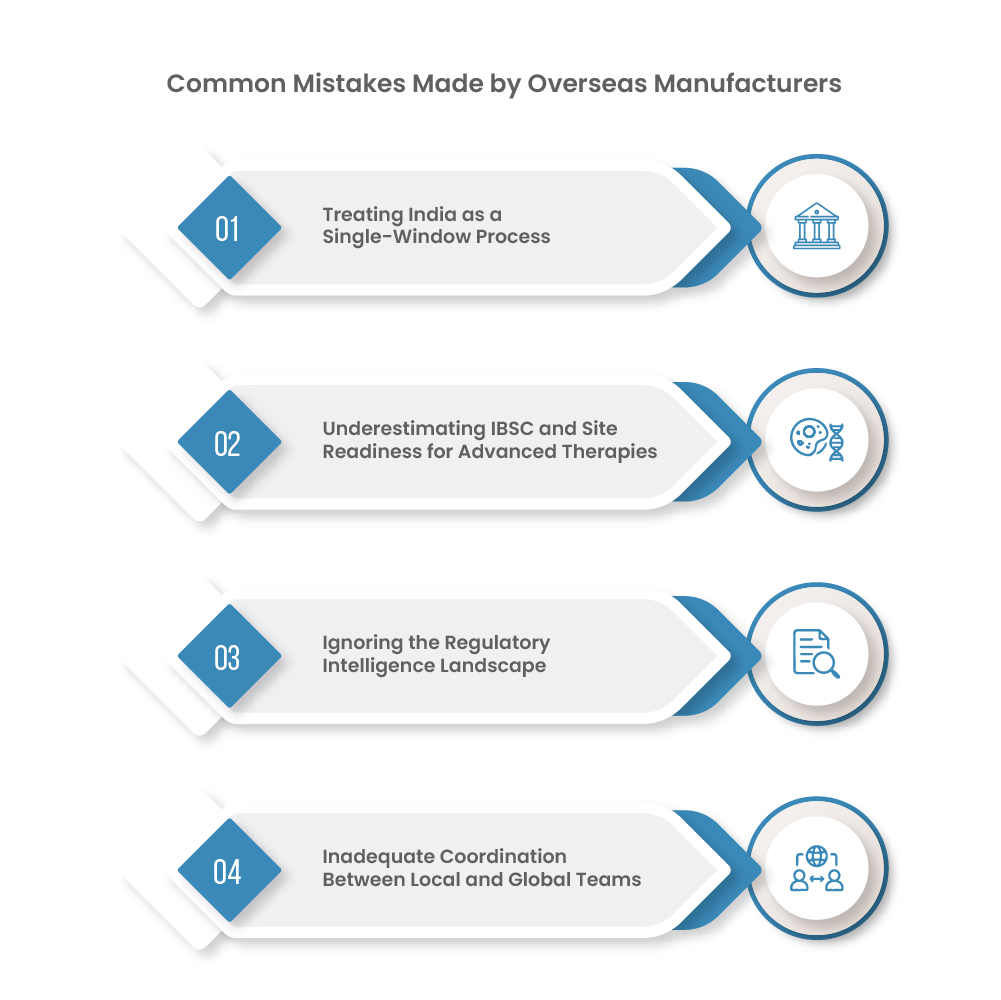
Figure1
Conclusion: Building the Right Regulatory Team
Successfully navigating India’s Biological Regulatory ecosystem requires a coordinated, multi-authority approach supported by deep institutional knowledge. Companies that invest in building — or partnering with — a team that understands not just CDSCO procedures but also RCGM, GEAC, NIB, and state authority processes will consistently outperform competitors that treat India as an extension of their existing regulatory model.
Ready to navigate India’s biologicals regulatory landscape? CliniExperts Services brings deep expertise across CDSCO, RCGM, DBT, and NIB pathways. Contact us for a complimentary regulatory feasibility assessment contact@cliniexperts.com
Recent Posts
CDSCO Online Portal (SUGAM) Guide for Drug Import Applications
Learn how to use the CDSCO SUGAM Portal for Drug Import applications in India. This guide explains registration, application submission, document requirements, and compliance steps for smooth regulato..
Schedule M GMP: Are Indian Pharmaceutical Manufacturers Really Ready?

The revision of Schedule M to India’s Drugs and Cosmetics Act represents one of the most consequential regulatory changes for domestic Pharmaceutical manufacturers in recent memory. Notified by ..
Need Help?
Submit your EnquiryOffice Locations
- Delhi
- Bangalore
- USA
- Singapore