
Table of Contents
Banned and Restricted Cosmetic Ingredients in India: The Updated List Every Global Brand Must Know


The Ingredient Compliance Imperative
For global Cosmetic brands, formulation approval in one major market — the EU, the US, or Japan is often viewed as a strong indicator of product safety and compliance. In India, this assumption can be costly. The Indian regulatory framework maintains its own list of banned and restricted Cosmetic ingredients, and while it shares significant overlap with international frameworks, the differences are consequential.
India’s Cosmetics regulatory framework, governed by the Cosmetics Rules, 2020, along with applicable BIS standards including IS 4707 (Part 1 and Part 2), establishes specific requirements for prohibited ingredients, restricted substances, permitted colourants, preservatives, UV filters, and labelling obligations. While there is significant alignment with international regulations, important differences remain that can directly impact product registration and market access.
The Regulatory Framework: How Cosmetic Ingredient Restrictions Are Governed in India
- India’s Cosmetic ingredient requirements are governed through a combination of the Cosmetics Rules, 2020, applicable Bureau of Indian Standards (BIS) specifications, and regulatory guidance issued by the Central Drugs Standard Control Organisation (CDSCO).
- Cosmetic ingredient compliance in India is primarily established through the following mechanisms:
- The Ninth Schedule of the Cosmetics Rules, 2020 specifies the applicable BIS standards for various categories of Cosmetic products.
- IS 4707 (Part 1): Classification of Cosmetic Raw Materials and Adjuncts provide a list of ingredients generally recognised as safe (GRAS) for use in Cosmetic formulations.
- IS 4707 (Part 2): Classification of Cosmetic Raw Materials and Adjuncts (GNRAS) identify substances that are prohibited, restricted, or subject to specific conditions of use in Cosmetic products.
- Product-specific BIS standards referenced in the Ninth Schedule prescribe additional requirements relating to composition, quality, testing methods, labelling, mandatory warnings, and permissible ingredients.
CDSCO may also issue product-specific or ingredient-specific circulars and guidelines restricting or banning specific substances. These are published through the CDSCO website and the Drugs Controller General (India)’s official communications. CosmoAlly, CliniExperts’ dedicated Cosmetics intelligence platform, tracks these updates in real time.
Prohibited Ingredients: Selected Key Bans
- Hydroquinone in Leave-On Skin Lightening Products
Hydroquinone, widely used globally as a skin-lightening active, is prohibited in Cosmetic Only allowed in Artificial nail system with 0.02% in India. CDSCO issued this restriction following safety reviews that aligned India’s position with several EU and international markets. Hydroquinone may be present in products dispensed under medical supervision (as a pharmaceutical) but cannot be marketed as a Cosmetic.
Brands bringing skin-brightening or skin-lightening products into India must review all active ingredients for hydroquinone presence and reformulate if necessary, before applying for COS-2 registration.
- Mercury Compounds
Cosmetics imported or manufactured in the country shall contain mercury in the following
proportions, namely, ﹘
(a) in Cosmetics intended for use only in the area of eye, the level of mercury not exceeding seventy
parts per million (0.007 per cent.) of mercury, calculated as the metal, as a preservative;
(b) in other finished Cosmetic products, unintentional mercury shall not exceed one part per million (1 ppm).
- Hexachlorophene
The use of hexachlorophene in Cosmetic products is generally prohibited in India.
However, under the Cosmetics Rules, 2020, hexachlorophene may be used in soaps at a concentration not exceeding 1.0% weight by weight (w/w).
Where hexachlorophene is used in soap formulations, the following cautionary statement must appear prominently and conspicuously on the product label:
“Contains hexachlorophene – not to be used on babies.”
- Chloroform
Chloroform is prohibited as a Cosmetic ingredient in India.
- Colourants
Only colourants permitted under the applicable BIS standards, including IS 4707 (Part 1 and Part 2) and relevant product-specific specifications referenced in the Ninth Schedule of the Cosmetics Rules, 2020, may be used in Cosmetic products in India. Manufacturers should verify each colourant’s regulatory status, applicable restrictions, and Colour Index (CI) number before product registration.
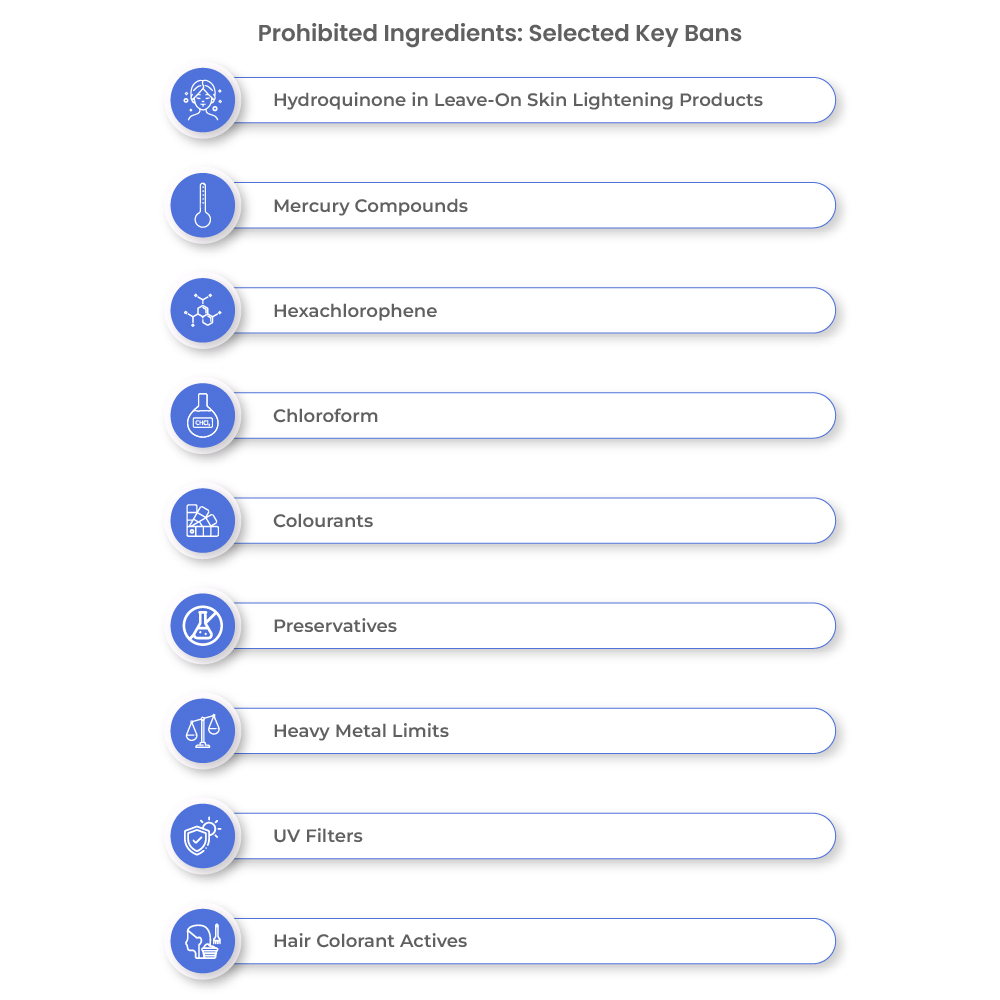
Figure 1
Restricted Ingredients: Key Compliance Considerations
| Preservative | Maximum Permitted Concentration | Usage Restriction |
| Parabens (individual) | 0.4% (as acid) in individual use | Not permitted in products intended for children under 3 or in nappy area products |
| Parabens (combined) | 0.8% (as acid) total | Same restrictions as individual limits |
| Phenoxyethanol | 1.0% | Not recommended for products intended for nappy area |
| Benzalkonium chloride | 0.1% (as benzalkonium chloride) | Not for use in aerosols |
| DMDM Hydantoin | 0.6% | Not for aerosols; formaldehyde-releasing status must be declared |
| MIT (Methylisothiazolinone) | 0.0015% (rinse-off only) | Not permitted in leave-on products |
| CMIT/MIT blend | 0.0015% | Rinse-off products only |
Table1
Heavy Metal Limits
As discussed in Article 4, Heavy metals such as lead, arsenic, and mercury are not permitted as intentional ingredients in Cosmetic products and may only be present as unavoidable trace impurities within the limits specified in the applicable BIS standards. Manufacturers should verify compliance through finished product testing, particularly for products with higher ingestion potential, such as lip Cosmetics
UV Filters
UV filters used in sunscreens and other SPF-labelled Cosmetic products must comply with the applicable BIS, including IS 4707 (Part 2) and Cosmetics Rules, 2020. Manufacturers and importers should verify the regulatory status of each UV filter before product registration, as ingredients permitted in the EU, US, or other markets may not be acceptable in India.
Hair Colorant Actives
Oxidative hair colourant ingredients — p-phenylenediamine (PPD), resorcinol, and related oxidative dyes — are subject to concentration limits and mandatory label warning requirements. p-Phenylenediamine must not exceed 2% in the final product, and the label must carry specified sensitisation warnings.
Animal Testing Prohibition
Rule 39(7) of the Cosmetics Rules, 2020 explicitly prohibits the testing of Cosmetics on animals in India. This prohibition applies to testing of the finished product and extends to Cosmetic ingredients where the testing is conducted in India.
For imported products, brands must ensure that their safety documentation does not reference animal testing conducted specifically for Cosmetic purposes — particularly for products imported from markets where Cosmetic animal testing may still occur. In practice, most global brands from EU, US, and major APAC markets will already be compliant with this requirement.
Microplastics: India’s Current Position
Several markets — notably the EU and the UK — have implemented or are implementing restrictions on intentionally added microplastics in Cosmetics. India has not yet implemented a blanket microplastics restriction in Cosmetics as of the time of writing, though the regulatory landscape is evolving. Brands should monitor CDSCO and BIS communications on this topic, particularly if their formulations contain polyethylene beads or other solid plastic particles.
Pre-Submission Ingredient Compliance Review: A Practical Framework
Every formulation intended for India import registration should undergo a structured pre-filing compliance audit. CliniExperts recommends the following framework:
- Generate a full INCI ingredient list with CAS numbers Actual Percentage and Functions of each ingredient
- Verification of ingredients against applicable restrictions under IS 4707 (Part 1 and Part 2)
- Assessment of preservatives, colourants, UV filters, and hair dye ingredients against relevant BIS specifications.
- Check heavy metal levels in the finished product CoA against BIS limits (category-specific)
- Review any hair colorant actives for PPD and related compound limits
- Verify no animal testing references in safety data for Cosmetic purposes
- Document compliance assessment with applicable rule/standard references for each ingredient
Key Takeaways
- Cosmetic ingredients intended for the Indian market must comply with the requirements of the Cosmetics Rules, 2020, applicable BIS standards, and relevant CDSCO guidance.
- The Ninth Schedule of the Cosmetics Rules, 2020 specifies the applicable BIS standards for different Cosmetic categories, while IS 4707 (Part 1 and Part 2) govern the use of permitted, restricted, and prohibited ingredients.
- Preservatives, colourants, UV filters, and hair dye ingredients are subject to specific concentration limits, conditions of use, and labelling requirements under the applicable BIS standards.
- Ingredients permitted in the EU, US, Japan, or other markets are not automatically acceptable in India and should be independently assessed for regulatory compliance.
- Testing of Cosmetics on animals is prohibited in India under Rule 39(7) of the Cosmetics Rules, 2020.
- A structured pre-submission ingredient compliance review is essential to minimise formulation-related deficiencies and streamline the Cosmetic registration process.
How CliniExperts Can Help
CliniExperts’ product and ingredient analysis service covers full BIS Ninth Schedule screening, CDSCO prohibited substance review, UV filter list verification, and preservative and colourant compliance — before you file, not after you receive a deficiency letter. We also maintain a live regulatory update tracker through our CosmoAlly platform. Contact us at contact@cliniexperts.com.

Saurangi is a food regulatory expert with 8 years of experience. She shares her knowledge and insights on regulatory updates, food trends, best practices, and news. Follow her for expert insights and practical advice on all things for food regulatory
Saurangi Shah
CliniExperts Services Pvt. Ltd.
Recent Posts
The Future of Biological Regulation in India: Biosimilars, CAR-T, AI & Advanced Therapies

India’s Biological Regulatory landscape is at an inflection point. The country that pioneered affordable Biosimilar access, built one of the world’s largest vaccine manufacturing ecosystem..
Recall Management for Medical Devices in India

A Recall is one of the few regulatory events where speed of response directly influences both patient safety outcomes and a company’s regulatory standing. Yet many manufacturers only consider their ..
How to Build an Indian Regulatory Strategy for Advanced Biologicals Before Entering the Market

The decision to enter the Indian market with an advanced Biological product should be made with a comprehensive regulatory strategy in place. India’s multi-authority regulatory environment, dist..
Need Help?
Submit your EnquiryOffice Locations
- Delhi
- Bangalore
- USA
- Singapore