
Table of Contents
The New CDSCO Environment: What Global Pharmaceutical Companies Must Know in 2026



Introduction
India’s Pharmaceutical regulatory landscape is undergoing its most significant transformation in decades. For global Pharmaceutical companies — whether entering the Indian market for the first time or managing long-standing manufacturing operations — understanding the new CDSCO environment is no longer optional. It is a strategic imperative.
The Central Drugs Standard Control Organisation (CDSCO) has accelerated its regulatory modernisation agenda throughout 2024 and 2025, and the momentum is continuing into 2026. Inspections are more rigorous. Expectations around Good Manufacturing Practice (GMP) compliance have been substantially elevated. Data integrity requirements that were once discussed theoretically are now active inspection criteria. And India’s alignment with global regulatory frameworks — including the World Health Organization (WHO), the Pharmaceutical Inspection Co-operation Scheme (PIC/S), and International Council for Harmonisation (ICH) guidelines — is reshaping what compliance actually means on the ground.
1. The Regulatory Modernisation Agenda: What Has Changed
India’s Pharmaceutical sector has long been one of the world’s largest exporters of generic medicines. A series of high-profile inspection failures at Indian manufacturing sites by the USFDA, EMA, and other stringent regulatory authorities created sustained pressure for domestic regulatory reform. CDSCO’s response has been structured and deliberate.
- Revised Schedule M: Strengthened GMP requirements now aligned closely with WHO TRS standards. Compliance timelines for large manufacturers have passed; extended deadlines for small and medium manufacturers are being actively monitored.
- Increased Inspection Frequency and Depth: CDSCO has significantly increased routine and unannounced GMP inspections. Teams now examine operational quality culture — how deviations are investigated, how CAPAs are implemented, and how training systems function.
- Stronger Data Integrity Expectations: Aligned with USFDA and EMA guidance, CDSCO inspectors now evaluate audit trails, backup systems, access controls, and completeness of electronic records.
- International Regulatory Convergence: India’s PIC/S engagement and ICH guideline adoption signal deliberate convergence toward internationally harmonised standards.
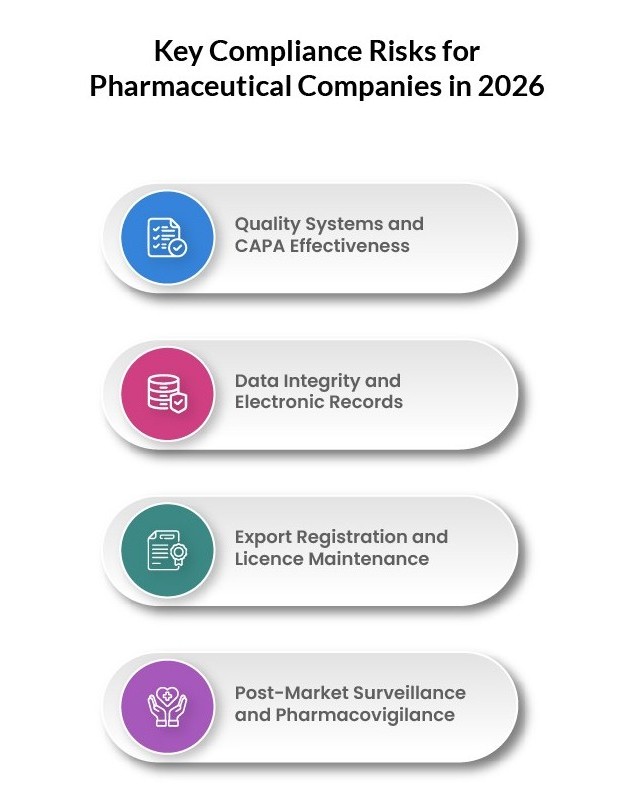
2. Key Compliance Risks for Pharmaceutical Companies in 2026
Quality Systems and CAPA Effectiveness: CDSCO inspectors probe the gap between documented procedures and actual practice. Ineffective CAPA systems are treated as evidence of systemic quality failure.
Data Integrity and Electronic Records: Data integrity failures remain among the most consequential findings globally. For Indian manufacturers supplying regulated markets, a domestic CDSCO data integrity observation can trigger parallel investigations by foreign regulators.
Export Registration and Licence Maintenance: Regulatory changes affecting excipients, packaging, or manufacturing site details require timely updates to avoid supply chain disruption.
Post-Market Surveillance and Pharmacovigilance: India’s Pharmacovigilance requirements have expanded. Companies marketing products in India need robust local signal detection and PSUR submission infrastructure.
3. Inspection Preparedness: A Strategic Imperative
Inspection readiness has evolved from a reactive checklist into a continuous operational discipline. High-performing organisations treat it as a component of normal business operations.
- Ongoing Mock Inspections: Structured internal mock inspections conducted by personnel not involved in the area under review.
- Self-Inspection Programmes: Formal, systematic self-inspection covering all GMP-critical areas on a defined schedule.
- SME Preparation: Pre-inspection briefing and scenario training for subject matter experts.
- Document Management: The ability to locate and produce any requested document quickly and accurately.
- CAPA Closure and Trend Analysis: Inspectors examine whether CAPAs are closed on time, effectiveness checks conducted, and deviation trends escalated.
4. Strategic Priorities for 2026
- Conduct a Gap Assessment Against Revised Schedule M: Prioritise this immediately if not yet completed. Use qualified regulatory and quality professionals with current knowledge of CDSCO inspection findings.
- Invest in Data Integrity Infrastructure: Requires investment in both systems (audit trail capabilities, access control, backup validation) and culture (training, accountability frameworks, escalation protocols).
- Build a Dedicated Regulatory Intelligence Capability: Establish a systematic process for monitoring, interpreting, and acting on CDSCO circulars and notifications.
- Align Domestic Compliance with Global Standards: Harmonised quality systems that meet both CDSCO and global regulatory expectations reduce overall compliance costs.
- Engage Qualified Regulatory Partners: Experienced regulatory advisory support provides expertise and independent perspective across inspection response, licence maintenance, and product registration strategy.
Conclusion
India’s Pharmaceutical regulatory environment in 2026 is characterised by greater rigour, higher expectations, and closer alignment with global standards than at any previous point in its history. Companies that invest in genuine compliance maturity position themselves for sustainable market access, stronger investor profiles, and meaningful competitive differentiation.
At CliniExperts, we work with Pharmaceutical companies across the full spectrum of regulatory complexity. If your organisation is evaluating its regulatory readiness for 2026 and beyond, we welcome the opportunity to discuss how we can support your objectives.
Recent Posts
How to Manufacture Class A & B Medical Devices in India: State FDA License Guide

A quick guide on the Class A & B Medical Device manufacturing license — covering State FDA rules, Form MD-3/MD-5, fees, and timelines for manufacturers. Every manufacturer entering India’s..
Importing Small Quantities of Cosmetics for R&D in India: NOC Requirements

A brief guide on Cosmetic import NOC India — covering when small quantity Cosmetic import for R&D testing bypasses full registration under Cosmetic rules 2020. Not every Cosmetic shipment into I..
The Cosmeceuticals Grey Zone: When a Cosmetic Claim Risks Becoming a Drug Claim

“Cosmeceutical” is a popular marketing word. It suggests something more powerful than an ordinary Cosmetic — a product that treats skin condition, not just improves appearance. The problem is th..
Get In Touch With Our Team
-
Email: contact@cliniexperts.com
-
Timings: 9 am to 6 pm (Monday to Friday)
-
Location: India: Delhi, Bangalore Global: USA, Singapore