
Table of Contents
80 Categories, One Product: How to Get Cosmetic Product Categorisation Right in India


The Categorisation Problem
Of all the challenges in India’s Cosmetic Import registration process, product categorisation is one of the most underestimated. Under the Cosmetics Rules, 2020, CDSCO has prescribed 80 Cosmetic categories under the Fourth Schedule. Every product included in a COS-1 application must be mapped to the appropriate category before submission of an application.
Get it right, and the application proceeds. Get it wrong — or assign a product to an ambiguous category without justification — and the application is likely to receive a query, creates additional documentation burden, and adds weeks or months to the timeline.
This article explains the categorisation principles generally applied during CDSCO Cosmetic registration reviews, discusses major category clusters with examples, addresses borderline and dual-category situations, and provides a practical decision framework for regulatory teams.
Why Does CDSCO Require Cosmetic Products to Be Categorised
Approximately 80 categories classified under Cosmetics Rules, 2020 CDSCO serve three regulatory purposes:
- They determine the fee applicable to each application,
- They define the ingredient and specification standards against which the product will be reviewed, and
- They establish the labelling requirements relevant to the product type.
Categories are not arbitrary groupings. They reflect the intended use, the region of the body where the product is applied, and — in some cases — the product’s physical form or delivery mechanism. A product that is applied to the lips is in a different regulatory category from a product applied to the face, even if both carry moisturising claims.
The Major Category Clusters
1. Skin Care Products
The skin care cluster is the largest category group and includes sub-categories such as face creams and moisturisers, eye creams, body lotions, hand creams, serums, face masks and peel-off products, and scrubs and exfoliants. The primary categorisation criterion is the site of application (face, eye area, body, hands) combined with the primary function (moisturising, cleansing and care).
2. Colour Cosmetics
Foundation, lipstick, lip gloss, mascara, eyeshadow, eyeliner, blush, bronzer, highlighter, nail makeup, and related products. Products intended for application around sensitive areas such as the lips and eyes often receive additional regulatory attention
3. Hair Care Products
Shampoos, conditioners, hair oils, hair colourants and bleaches, hair styling products (gels, sprays, waxes), anti-dandruff, and anti-hair loss products. Hair dyes and bleaching products require particular attention to ingredient declarations, formulation and Label compliance.
4. Oral Hygiene Products
Toothpastes, mouthwashes, teeth whitening products, and breath fresheners. These products are often assessed against specific BIS requirements and product standards, and the ingredient requirements are notably more specific than other Cosmetic categories.
5. Sun Care Products
Sunscreens (SPF products), after-sun preparations, self-tanning products, and bronzing lotions. Sunscreens in India are a regulated sub-category that requires declaration of UV filter types, SPF values, and compliance with permitted UV filter lists.
6. Nail Care Products
Nail lacquers, nail hardeners, nail polish removers, nail care creams, and cuticle products.
7. Perfumes and Deodorants
Fragrances, eau de toilette, eau de parfum, deodorant sticks, sprays, and antiperspirants. Product claims should be carefully reviewed to ensure they remain within the scope of Cosmetic regulations.
8. Shaving and Grooming Products
Shaving creams, aftershave lotions, shaving gels, and men’s grooming preparations.
9. Baby and Child Products
Baby shampoos, baby oils, baby powders, baby lotions, and nappy creams. These products typically require careful evaluation of ingredient suitability and safety
Categorisation Criteria: The Decision Logic
- When reviewing a Cosmetic product for import registration, categorisation should be based on regulatory principles—not marketing descriptions. A practical decision framework is:
- Identify the primary intended use — what is the product’s main function?
- Identify the area of application — Is the product intended for the face, lips, eyes, hair, scalp, nails, oral or body?
- Identify the product form — rinse-off or leave-on? This matters for certain ingredient limits.
- Review any special claims — SPF, hair loss, anti-dandruff, hair dye. Each may trigger a specific sub-category or additional regulatory requirements.
- Confirm the Product Falls Within the Cosmetic Definition — any therapeutic or medicinal claim disqualifies the product from Cosmetic registration.
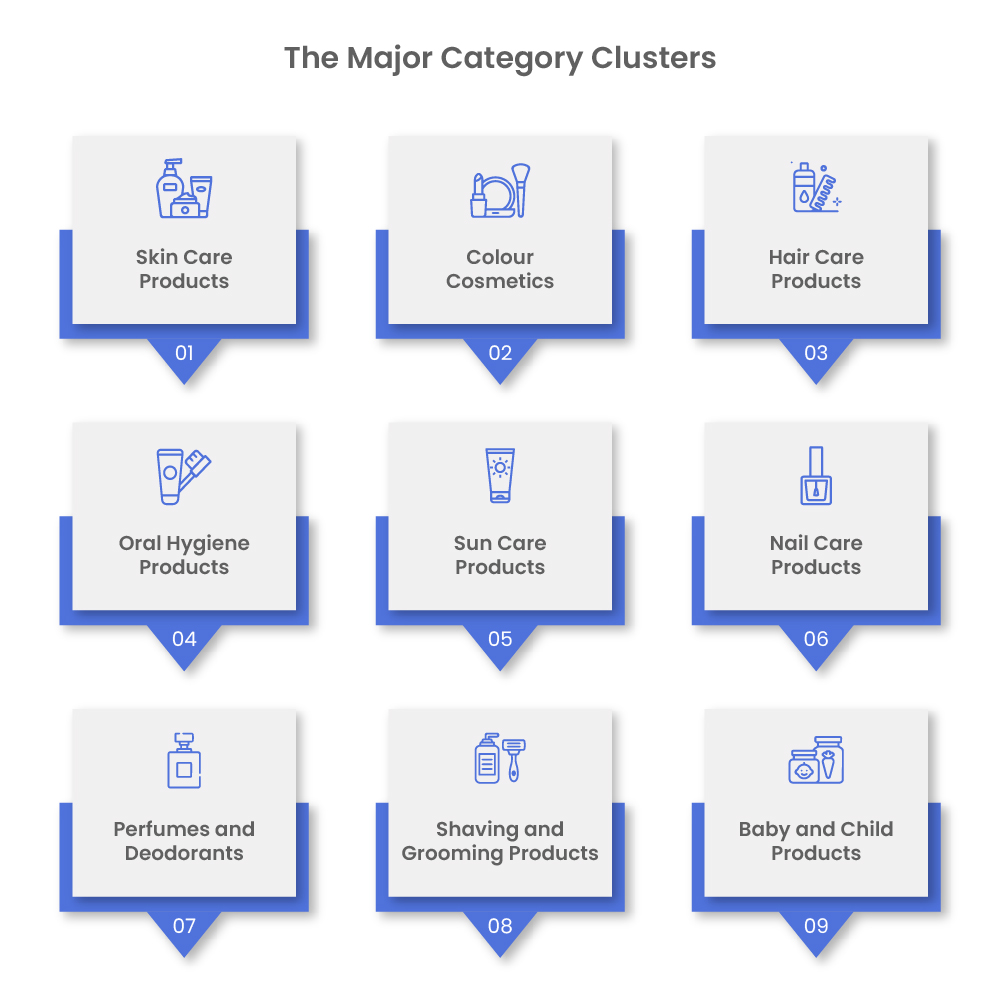
Figure1
Borderline and Dual-Category Situations
The borderline cases — products that could reasonably sit in two categories — are where experienced regulatory judgment becomes essential. Some common examples:
| Product | Category Challenge | Recommended Approach |
| Tinted moisturiser with SPF 15 | Skin care + colour Cosmetics + sun care | File under the category that reflects the primary use and label claim; document the rationale |
| Anti-dandruff shampoo | Hair care + treatment claims | Hair care is correct; ensure ‘treatment’ language is removed from label |
| BB cream / CC cream | Skin care + colour Cosmetics | Categorise based on the dominant claim; if SPF is present, add sun protection category |
| Teeth whitening strips | Oral hygiene vs. borderline drug claim | Oral hygiene if claim is Cosmetic whitening; drug pathway if therapeutic claim is present |
| Anti-Hair loss serum | Hair care — but hair loss claims require careful review | Hair care; ensure claims stay within Cosmetic definition; ‘promotes healthy hair’ vs. ‘reverses hair loss’ |
Table 1
Impact of Mis categorisation
Mis categorisation at the application stage has a cascade of consequences:
- CDSCO raises a query requesting justification for the selected category or requesting re-categorisation
- Requests to revise application documents, product specifications, labels, Cover letter and Part 1.
- Additional review cycles and extended approval timelines
Based on practical experience with Cosmetic registration applications, categorisation-related queries can add an average of two to four months to the approval timeline. In many cases, these delays can be avoided through a thorough pre-filing categorisation review
Key Takeaways
- CDSCO has defined approximately 80 product categories; every COS-1 application must correctly assign each product to the right category
- Categorisation is based on intended use, area of application, product form, and any special claims (SPF, anti-dandruff, anti-hair loss, tooth whitening)
Conducting a thorough categorisation review before submission is one of the most effective ways to minimise regulatory risk and facilitate a smoother approval process.
How CliniExperts Can Help
CliniExperts’ Cosmetic regulatory team conducts pre-filing product categorisation reviews for every COS-2 application — drawing on our experience with 350+ product types across 30+ countries of origin. If you are unsure whether your product falls into one category or two, or if a special claim might push it toward drug classification, contact us before filing at contact@cliniexperts.com.
Recent Posts
How to Manufacture Class A & B Medical Devices in India: State FDA License Guide

A quick guide on the Class A & B Medical Device manufacturing license — covering State FDA rules, Form MD-3/MD-5, fees, and timelines for manufacturers. Every manufacturer entering India’s..
Importing Small Quantities of Cosmetics for R&D in India: NOC Requirements

A brief guide on Cosmetic import NOC India — covering when small quantity Cosmetic import for R&D testing bypasses full registration under Cosmetic rules 2020. Not every Cosmetic shipment into I..
The Cosmeceuticals Grey Zone: When a Cosmetic Claim Risks Becoming a Drug Claim

“Cosmeceutical” is a popular marketing word. It suggests something more powerful than an ordinary Cosmetic — a product that treats skin condition, not just improves appearance. The problem is th..
Get In Touch With Our Team
-
Email: contact@cliniexperts.com
-
Timings: 9 am to 6 pm (Monday to Friday)
-
Location: India: Delhi, Bangalore Global: USA, Singapore