
Table of Contents
Schedule M Revisions: How Will They Impact Pharmaceutical Manufacturers?



What a Revised Schedule M raises GMP standards in India, what has changed for manufacturers, and how large firms and MSMEs can prepare for Compliance and CDSCO inspections.
Revised Schedule M is the biggest overhaul of manufacturing rules for Indian Pharma in two decades. It moves the industry from basic facility checklists to a modern, risk-based quality approach.
For manufacturers, this is more than a paperwork update. It affects facilities, systems, staff training, and budgets, and it applies to large companies and small units alike.
Revised Schedule M Under the Drugs and Cosmetics Rules 1945
Schedule M sits within the Drugs and Cosmetics Rules 1945 and sets Good Manufacturing Practices for Drug makers. The Ministry of Health and Family Welfare notified the revised version in December 2023.
The revision was driven by quality concerns, including overseas incidents linked to contaminated Indian-made syrups. Regulators wanted Indian plants to meet the same standards expected by global buyers.
WHO-GMP Alignment: Why the Standards Changed
The new rules bring Indian GMP close to WHO-GMP and other international guidance. This WHO-GMP alignment narrows the gap between export-focused plants and units supplying only the domestic market.
The aim is simple: one quality standard for every medicine made in India, wherever it is sold.
New Schedule M GMP Requirements and the Pharmaceutical Quality System
At the heart of the revision is a formal Pharmaceutical quality system (PQS). Senior management is now directly accountable for product quality, not just the quality department.
Key Schedule M GMP requirements include:
- Quality Risk Management: Risks to product quality must be identified, assessed and controlled.
- Product Quality Review: Each product needs a regular review of batches, deviations and trends.
- Validation and qualification: Equipment, processes, cleaning methods and computer systems must be validated.
- Stability studies: Shelf-life claims must be backed by proper stability data.
- Supplier qualification: Raw material and packaging suppliers must be audited and approved.
- Change control and CAPA: Changes and deviations need documented investigation and corrective action.
Old vs Revised Schedule M: What Has Changed
The table below compares the earlier framework with the revised rules.
| Area | Old Schedule M | Revised Schedule M |
| Approach | Facility and equipment focused | Risk-based quality system |
| Quality system | Not formally defined | Mandatory pharmaceutical quality system |
| Risk management | Not required | Quality Risk Management required |
| Product review | Limited | Annual Product Quality Review |
| Validation | Basic process validation | Equipment, process, cleaning and computer system validation |
| Suppliers | Minimal checks | Formal supplier qualification and audits |
| Global benchmark | Below WHO-GMP | Aligned with WHO-GMP |
Table 1
Impact on Pharmaceutical Manufacturers: Large Firms vs MSMEs
The impact on pharmaceutical manufacturers depends heavily on size. Large companies with turnover above ₹250 crore had to comply first, and many already met WHO-GMP for export markets.
For them, the work is mainly about closing documentation and system gaps. Most of the physical infrastructure is usually already in place.
MSME Pharma Compliance: The Biggest Challenge
MSME Pharma Compliance is harder. Smaller units with turnover of ₹250 crore or less often need structural upgrades to plant layouts, HVAC, water systems and laboratories.
Eligible MSMEs that filed a Form A upgrade plan were given until 31 December 2025. Further relief has been under discussion, so units should check the latest CDSCO notifications.
Common pressures for small manufacturers include:
- High capital cost of facility upgrades
- Shortage of trained quality and validation staff
- Production downtime during renovation
- Risk of licence suspension after failed inspections
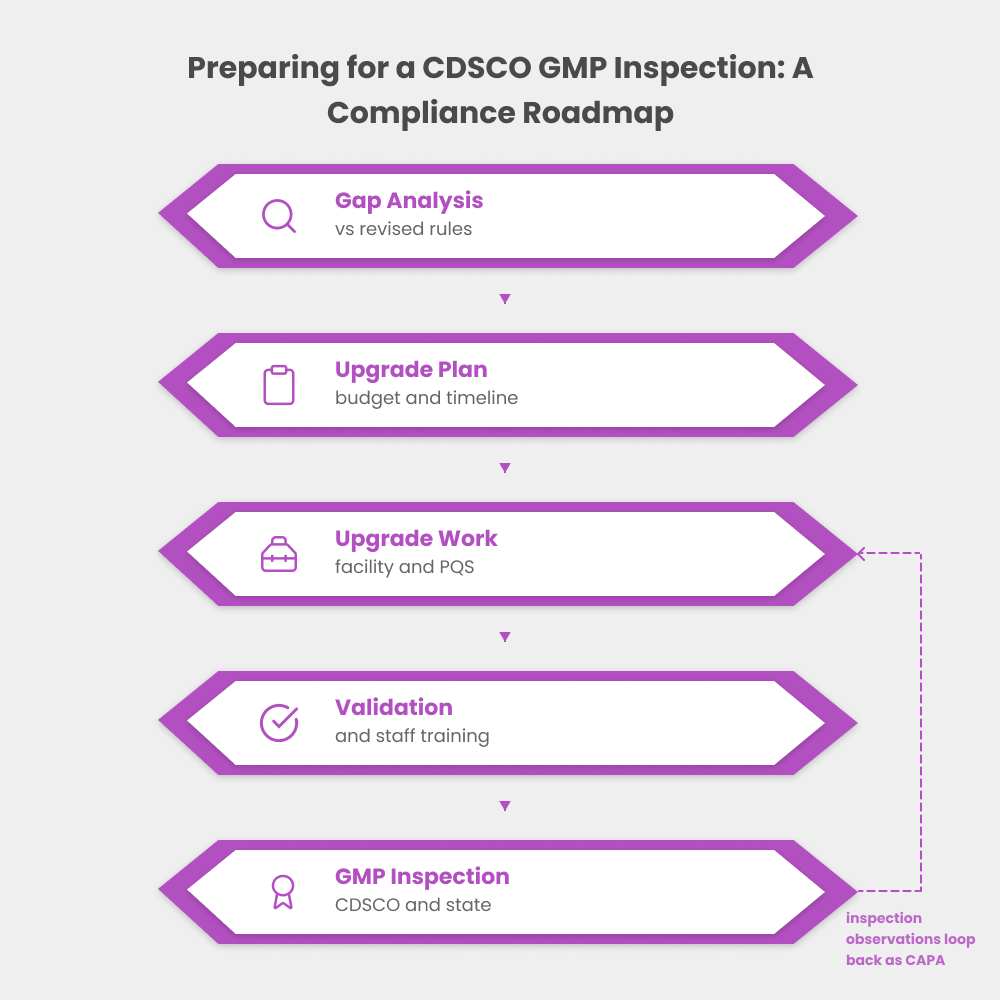
Figure1
Good Manufacturing Practices India: Getting Expert Support
Meeting Good Manufacturing Practices India now expects is a multi-year effort. Many manufacturers bring in outside specialists to speed up gap analysis, documentation, and staff training.
CliniExperts Offering Pharmaceutical Quality and Compliance services, including GMP and GxP support for Drug Manufacturers. It has also run expert webinars on aligning with the new Schedule M.
Its wider regulatory support, from Manufacturing Licences to Post-approval changes, helps manufacturers keep licences and quality systems in step.
Conclusion
Revised Schedule M marks India’s shift to global-standard quality manufacturing. It demands investment, but it also strengthens trust in Indian medicines at home and abroad.
Manufacturers that treat Revised Schedule M as a quality upgrade, not a compliance burden, will be best placed to pass inspections and compete globally.
Recent Posts
CDSCO vs US FDA vs EMA: Why the Same Drug Faces Different Approval Requirements
A practical comparison of CDSCO vs FDA vs EMA, explaining how each regulator’s Drug approval process differs and why one Drug needs separate approvals in India, the US and Europe. A Drug approve..
How to Manufacture Class A & B Medical Devices in India: State FDA License Guide

A quick guide on the Class A & B Medical Device manufacturing license — covering State FDA rules, Form MD-3/MD-5, fees, and timelines for manufacturers. Every manufacturer entering India’s..
Get In Touch With Our Team
-
Email: contact@cliniexperts.com
-
Timings: 9 am to 6 pm (Monday to Friday)
-
Location: India: Delhi, Bangalore Global: USA, Singapore