
Table of Contents
CDSCO vs US FDA vs EMA: Why the Same Drug Faces Different Approval Requirements


A practical comparison of CDSCO vs FDA vs EMA, explaining how each regulator’s Drug approval process differs and why one Drug needs separate approvals in India, the US and Europe.
A Drug approved in the United States is not automatically approved in India or Europe. Comparing CDSCO vs FDA vs EMA shows why the drug approval process changes from one market to the next.
Each regulator answers to its own laws, population, and public health priorities. For sponsors, understanding these differences early saves time, money, and repeated studies.
CDSCO Drug Approval Under the New Drugs and Clinical Trials Rules 2019
In India, the Central Drugs Standard Control Organisation (CDSCO), headed by the Drugs Controller General of India (DCGI), regulates New Drugs. The New Drugs and Clinical Trials Rules 2019 set the framework with Drugs and Cosmetics act 1940 & rules 1945.
Applications are reviewed with input from a Subject Expert Committee (SEC). The key steps in CDSCO drug approval include:
- Permission to conduct Clinical Trials, including local Phase III data where required
- Submission of the New Drug application with safety, efficacy and quality data
- SEC review and recommendation to the DCGI
- Grant of marketing permission and post-marketing safety reporting
The 2019 Rules also allow a local clinical trial waiver in certain cases. This applies mainly to drugs already approved in notified countries such as the US, UK, EU members, Japan, Australia and Canada.
Even with a waiver, CDSCO may ask for Phase IV studies or other data relevant to Indian patients.
The US FDA Approval Process
The US Food and Drug Administration (FDA) reviews drugs through its Center for Drug Evaluation and Research. Sponsors first file an Investigational New Drug (IND) application before starting human trials.
After Phase I to III trials, the sponsor submits a New Drug Application (NDA) or, for biologics, a Biologics License Application (BLA). A standard review usually targets about 10 months.
The US FDA approval process also offers expedited pathways:
- Fast Track designation for serious conditions with unmet needs
- Breakthrough Therapy designation for substantial early improvement
- Priority Review, with a target of about 6 months
- Accelerated Approval based on surrogate endpoints
EMA Marketing Authorisation in the European Union
The European Medicines Agency (EMA) assesses medicines for the EU. Under various procedures one is centralised procedure; one application can lead to a single EMA marketing authorisation valid across all member states.
The Committee for Medicinal Products for Human Use (CHMP) evaluates the Marketing Authorisation Application (MAA). Its standard assessment runs up to 210 active days, excluding clock stops.
The CHMP then issues an opinion, and the European Commission makes the legally binding decision. Accelerated assessment and conditional marketing authorisation are available for medicines addressing major public health needs.
Regulatory Approval Requirements: CDSCO vs FDA vs EMA at a Glance
The table below compares the main regulatory approval requirements across the three agencies.
| Parameter | CDSCO (India) | US FDA | EMA (EU) |
| Governing framework | Drugs and Cosmetics Act1940 & rules 1945; NDCT Rules 2019 | Federal Food, Drug, and Cosmetic Act | EU Regulation (EC) No 726/2004 |
| Main application | New Drug application with CT data | NDA or BLA | MAA (centralised procedure) |
| Expert review body | Subject Expert Committee | FDA review divisions, advisory committees | CHMP |
| Final decision | DCGI | FDA | European Commission |
| Local trial data | Often required; waiver possible | Global data accepted if applicable to US | Global data accepted if applicable to EU |
| Fast pathways | Accelerated approval, CT waiver | Fast Track, Breakthrough, Priority Review, Accelerated Approval | Accelerated assessment, conditional MA, PRIME |
| Coverage | India | United States | All EU member states |
Table 1
Drug Approval Process: How One Drug Moves Through Each Regulator
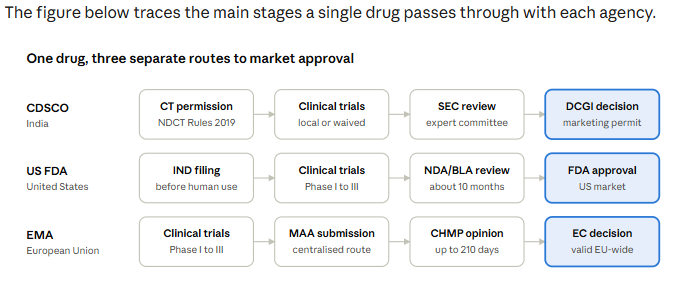
.
Why Clinical Trial Requirements Differ Across Regulators
The same molecule can face different clinical trial requirements for several reasons:
- Population & environmental differences: Genetics, environment, diet and disease patterns can change how a drug works, so regulators may want local or bridging data.
- Legal frameworks: Each agency follows its own national or regional laws.
- Public health priorities: Unmet medical needs shape which drugs get fast-tracked.
- Risk-benefit judgment: Expert committees may weigh the same data differently.
- Post-marketing obligations: Pharmacovigilance and Phase IV commitments vary by market.
ICH guidelines have narrowed these gaps, but full harmonisation is still far off. Sponsors therefore need a market-specific plan from the earliest stage of development.
The Role of Global Regulatory Affairs Support
Good global regulatory affairs planning helps sponsors design one development programme that meets several agencies’ needs. This reduces duplicate trials and delays.
Specialist firms such as CliniExperts support New Drug approval, subsequent New Drug approval, test licences and post-approval changes in India.
CliniExperts also offers clinical trial services through its research arm and regulatory services for the EU, UK and USA, helping sponsors build country-specific strategies from early development.
Conclusion
The CDSCO vs FDA vs EMA comparison shows that the Drug approval process is shaped by local law, population needs and public health goals. An approval in one market is a strong start, not a passport.
Sponsors that plan for each regulator early, with expert support, can reach patients in India, the US and Europe faster and with fewer repeated studies.
Summary
- CDSCO, US FDA and EMA each follow separate laws and review systems.
- In India, the New Drugs and Clinical Trials Rules 2019 govern approvals, with SEC review and DCGI decision.
- The US FDA reviews NDAs and BLAs and offers several expedited pathways.
- EMA’s centralised procedure gives one marketing authorisation for the whole EU.
- Local trial data needs differ; India may waive trials for drugs approved in notified countries.
- Early global regulatory affairs planning cuts duplicate studies and delays.
Recent Posts
How to Manufacture Class A & B Medical Devices in India: State FDA License Guide

A quick guide on the Class A & B Medical Device manufacturing license — covering State FDA rules, Form MD-3/MD-5, fees, and timelines for manufacturers. Every manufacturer entering India’s..
Importing Small Quantities of Cosmetics for R&D in India: NOC Requirements

A brief guide on Cosmetic import NOC India — covering when small quantity Cosmetic import for R&D testing bypasses full registration under Cosmetic rules 2020. Not every Cosmetic shipment into I..
Get In Touch With Our Team
-
Email: contact@cliniexperts.com
-
Timings: 9 am to 6 pm (Monday to Friday)
-
Location: India: Delhi, Bangalore Global: USA, Singapore