
Table of Contents
CAR-T and Cell & Gene Therapy Regulation in India: What Global Developers Must Know



India’s Emerging Advanced Therapy Landscape
Cell and Gene therapies — and chimeric antigen receptor T-cell (CAR-T) therapies in particular — represent one of the most transformative frontiers in modern medicine. With a large cancer patient population, growing hematology and oncology infrastructure at tertiary centers, and a government actively incentivising advanced manufacturing, India is positioning itself as both a market and an innovation hub for advanced therapy Medicinal products (ATMPs).
However, the Regulatory landscape for CAR-T and cell & Gene therapies in India is significantly more complex than for conventional biologics. Unlike a Biosimilar application that flows through a single primary pathway at CDSCO, advanced therapies require engagement with multiple Regulatory and scientific bodies — each with distinct mandates, review timelines, and technical expectations.
This article provides a comprehensive roadmap for global developers seeking to understand and navigate India’s advanced therapy regulatory framework.
The Multi-Authority Regulatory Architecture
CDSCO / DCGI — Primary Drug Regulatory Authority
The Central Drugs Standard Control Organisation (CDSCO), under the Drug Controller General of India (DCGI), is the primary Regulatory authority for CAR-T and Gene therapy products in India. All Clinical Trial applications (Form CT-04 under the New Drugs and Clinical Trials Rules, 2019) and marketing authorisation (Form CT-18/CT-21) applications for these products must be routed through CDSCO.
CDSCO applies the New Drug definition to advanced therapies, meaning CAR-T products, viral vector-based Gene therapies, and ex vivo cell therapy products all require full New Drug approval with Clinical data generated in Indian populations unless an exemption is justified.
RCGM — Review Committee on Genetic Manipulation
The Review Committee on Genetic Manipulation (RCGM), operating under the Department of Biotechnology (DBT), has oversight over all activities involving genetically modified organisms (GMOs) and recombinant DNA technology. For CAR-T therapies — which involve genetic modification of T-cells — RCGM approval is mandatory before any clinical activity can commence in India.
RCGM evaluates the contained use of genetically modified cells, the biosafety classification of viral vectors used for transduction (typically lentiviral or retroviral vectors), and the environmental risk assessment associated with manufacturing and clinical use.
IBSC — Institutional Biosafety Committee
Each Clinical Trial site and manufacturing facility working with genetically modified cells must have a functioning Institutional Biosafety Committee (IBSC) registered with RCGM. The IBSC is responsible for site-level biosafety review, approval, and ongoing oversight of advanced therapy activities.
For global developers entering India for the first time, identifying hospitals with functional, RCGM-registered IBSCs is a critical early step in site feasibility. Not all leading oncology centres in India have IBSCs in place, and establishing one — or upgrading an existing committee — can take six to twelve months.
DBT — Department of Biotechnology
The Department of Biotechnology provides the broader policy framework for advanced therapy development in India and administers the RCGM. For CAR-T developers, DBT is an important stakeholder in the context of Make in India initiatives, technology transfer programmes, and national biologics policy.
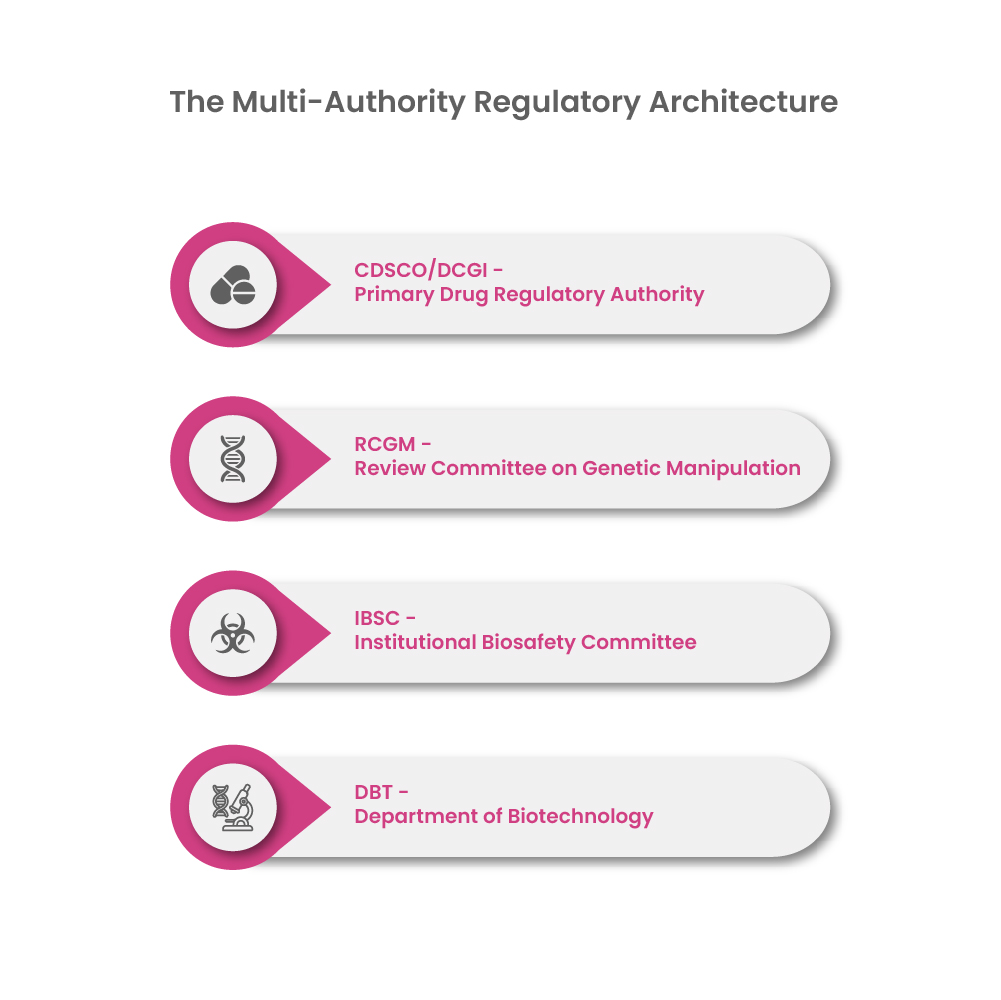
Figure1
Clinical Trial Requirements for CAR-T Therapies
India’s New Drugs and Clinical Trials Rules, 2019 (NDCT Rules) apply fully to CAR-T and Gene therapy Clinical Trials. Key requirements include:
- Phase I trials in Indian patients: CDSCO requires Clinical data from Indian patients even for products with extensive Phase I/II data from the US or EU. Companies can apply waiver of certain Phase I components based on prior data, but full waiver is rarely granted for CAR-T products due to immunological variability across populations.
- Ethics Committee approval: All advanced therapy trials require approval from an Ethics Committee registered with the Central Ethics Committee on Human Research (CECHR). For CAR-T trials, the ethics committee must be equipped to evaluate complex informed consent requirements, long-term follow-up obligations, and Gene therapy-specific risks.
- Long-term follow-up: CDSCO requires long-term safety follow-up data for CAR-T and Gene therapy products, consistent with global norms. A minimum 15-year follow-up commitment is typically expected, with annual reporting requirements.
- Serious adverse event reporting: Enhanced SAE reporting timelines apply to advanced therapy trials in India, reflecting the potentially severe toxicity profiles (cytokine release syndrome, neurotoxicity) associated with CAR-T therapies.
Manufacturing Considerations
One of the most complex aspects of CAR-T therapy development in India is manufacturing. Autologous CAR-T products — manufactured from the patient’s own T-cells — present particular logistical challenges in the Indian context:
- Apheresis infrastructure: Leukapheresis collection must occur at sites with certified equipment and trained staff. CDSCO expects leukapheresis sites to be included in the Clinical Trial authorisation.
- Manufacturing facility: The GMP manufacturing facility for CAR-T products must comply with Schedule M requirements and may require RCGM containing use approval for lentiviral vector manufacturing.
- Chain of identity and chain of custody: CDSCO expects rigorous documentation of the chain of identity (confirming cells are returned to the correct patient) and chain of custody (tracking from collection through infusion).
- Cold chain logistics: For centrally manufactured CAR-T products, international cold chain logistics between the manufacturing site and Indian clinical centers must be validated and included in the regulatory submission.
Allogeneic CAR-T products — manufactured from donor T-cells — present a different risk profile but similar regulatory expectations, with additional scrutiny on donor selection, testing, and traceability.
India Commercialisation Models
For CAR-T products that have received approval or conditional approval in the US or EU, India offers several potential commercialisation strategies:
- Full Indian programmed: Conducting an India-specific clinical programmed leading to independent CDSCO approval. This is the most comprehensive route and provides the strongest regulatory standing.
- Bridging approach: Leveraging foreign Clinical data supplemented by a limited India bridging study. CDSCO has shown openness to this approach for products with strong SRA approvals, particularly for rare or life-threatening conditions.
- Academic/hospital collaboration: Partnering with leading Indian academic medical centers that have their own advanced therapy manufacturing capabilities. This model is evolving rapidly in India, with institutions such as Christian Medical College Vellore and AIIMS establishing CAR-T research programmes.
- Technology transfer and Make In India: Licensing manufacturing technology to an Indian partner under a technology transfer arrangement. This model is actively supported by the government and may provide access to expedited regulatory interactions.
Key Challenges and Strategic Recommendations
- Start multi-authority engagement early: RCGM and IBSC processes have long lead times. Begin regulatory engagement at least 18 months before anticipating Clinical Trial initiation.
- Select sites strategically: Prioritise hospitals with existing IBSC registration, hematology/oncology expertise, and leukapheresis capability.
- Prepare for Indian ethnic data requirements: CDSCO expects data or a justification framework addressing potential ethnic differences in immunological response, cytokine profiles, and CAR-T expansion kinetics.
- Build a robust pharmacovigilance framework: India’s enhanced safety reporting requirements for advanced therapies require dedicated infrastructure, including a local qualified person for pharmacovigilance (QPPV equivalent).
Conclusion
India is at an inflection point in advanced therapy regulation. The multi-authority framework — while complex — reflects a thoughtful approach to managing the unique risks of CAR-T and Gene therapies. Global developers who invest in understanding this framework early, build relationships with key institutions, and develop genuinely India-specific regulatory strategies will be well-positioned to participate in what is likely to become one of the world’s most significant advanced therapy markets.
Ready to navigate India’s biologicals regulatory landscape? CliniExperts Services brings deep expertise across CDSCO, RCGM, DBT, and NIB pathways. Contact us for a complimentary regulatory feasibility assessment. contact@cliniexperts.com
Recent Posts
How to Manufacture Class A & B Medical Devices in India: State FDA License Guide
A quick guide on the Class A & B Medical Device manufacturing license — covering State FDA rules, Form MD-3/MD-5, fees, and timelines for manufacturers. Every manufacturer entering India’s..
Importing Small Quantities of Cosmetics for R&D in India: NOC Requirements
A brief guide on Cosmetic import NOC India — covering when small quantity Cosmetic import for R&D testing bypasses full registration under Cosmetic rules 2020. Not every Cosmetic shipment into I..
The Cosmeceuticals Grey Zone: When a Cosmetic Claim Risks Becoming a Drug Claim

“Cosmeceutical” is a popular marketing word. It suggests something more powerful than an ordinary Cosmetic — a product that treats skin condition, not just improves appearance. The problem is th..
Get In Touch With Our Team
-
Email: contact@cliniexperts.com
-
Timings: 9 am to 6 pm (Monday to Friday)
-
Location: India: Delhi, Bangalore Global: USA, Singapore