
Table of Contents
Decoding Government Fees for Cosmetic Import Registration in India



Introduction: The Cost Question Every Importer Asks First
Before a global Cosmetic brand commits to entering the Indian market, one of the first questions its regulatory or finance team asks is: what will the government registration fees cost? The answer is more nuanced than it first appears — and underestimating or miscalculating fees is one of the most common causes of application deficiencies and unexpected delays.
This article breaks down the three-component fee structure for Cosmetic Import registration in India, explains how each component is defined, walks through realistic cost scenarios for different brand profiles, and provides practical guidance on avoiding fee-related errors in the SUGAM portal.
The Three-Tier Fee Structure
Under the Cosmetics Rules, 2020, the government fees for obtaining an Import Registration Certificate (Form COS-2) are structured as follows:
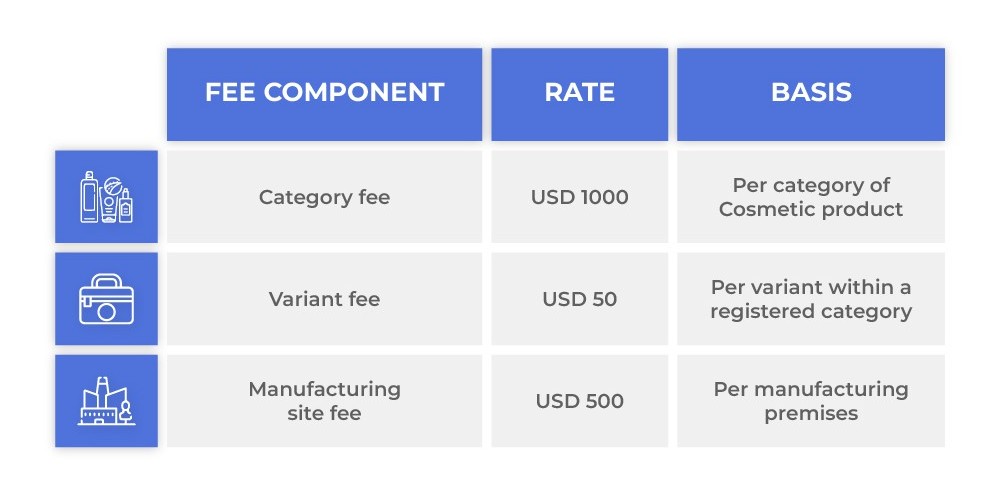
These three components are additive — every COS-2 application fee is calculated by summing the applicable category fees, variant fees, and site fees for that specific application.
Understanding the Fee Components
Category Fee — USD 1000 per Category
A ‘category’ under the Cosmetics Rules 2020 refers to one of approximately 80 defined product categories maintained by CDSCO. Examples include Face care products other than face mask, other hair and scalp care and cleansing products, Lip stick, Nail varnish / Nail make-up, Before and after sun products Sun protection products, and oral hygiene products, among many others.
Each unique category in which you wish to register a product attracts a USD 1000 fee. If your brand is registering a face cream and a shampoo in the same application, that is two categories — USD 2000 in category fees alone.
The category fee represents the administrative cost of CDSCO reviewing and approving a product for a defined use segment. It is the largest single fee component and the one most often underestimated when a brand is registering a broad portfolio.
Variant Fee — USD 50 per Variant
A ‘variant’ refers to a different colour/shade or flavour of a product within the same category and the same formulation. For example, a lipstick available in Red, Pink, Brown shade constitutes one product with three variants.
Each variant beyond the base product registration attracts a USD 50 fee. While USD 50 per variant appears modest, brands with multiple variant ranges — which is common in categories like Lipstick, Foundation, and Fragrance — can accumulate significant variant fees across a portfolio.
It is important to note that a change in formulation — even a minor one — does not constitute a variant. It constitutes a different product and requires its own category registration. Variants are strictly defined as different colour/shade or flavour within an identical formulation.
Manufacturing Site Fee — USD 500 per Site
Every manufacturing premises from which the imported products originate must be registered. Each unique manufacturing site attracts a USD 500 fee. If a brand sources the same product from two different manufacturing facilities (for example, one in France and one in South Korea), both sites must be declared, and both attract the USD 500 fee.
Cost Modelling: Real-World Scenarios
Scenario A: Single-Product, Single-Site Brand
A Korean skincare brand wishes to register one anti-ageing face serum (one category, no variant, one manufacturing site in Seoul) for import into India.
| Component | Calculation | Amount (USD) |
| Category fee | 1 category × USD 1,000 | 1,000 |
| Variant fee | 0 additional variants | 0 |
| Site fee | 1 manufacturing site × USD 500 | 500 |
| Total Government Fee | 1,500 |
Table1
Scenario B: Mid-Size Brand with Multiple SKUs
A European Cosmetics company wishes to register 3 categories (face cream, body lotion, hair shampoo) with 2 variants each, sourced from 2 manufacturing sites.
| Component | Calculation | Amount (USD) |
| Category fee | 3 categories × USD 1,000 | 3,000 |
| Variant fee | 3 categories × 2 variants × USD 50 | 300 |
| Site fee | 2 manufacturing sites × USD 500 | 1,000 |
| Total Government Fee | 4,300 |
Table 2
How Fees Are Paid: The SUGAM Challan Process
Fee payment is completed online through the SUGAM Bharat Kosh portal at the time of application filing. The portal generates a payment challan after the application details are entered and confirmed. Payment can be made via net banking or other approved online payment methods.
The generated challan — which includes the applicant’s details, the application reference number, and the fee amount — must be uploaded as part of the application dossier. A discrepancy between the challan amount and the fees expected for the application profile is one of the most common causes of deficiency letters at the CDSCO query stage.
Common Fee-Related Errors and How to Avoid Them
- Undercounting categories: failing to recognise that a single product touches two regulatory categories (e.g., a tinted moisturiser that could fall under both skin care and colour Cosmetics)
- Missing variant declarations: registering the primary pack size but omitting additional pack sizes — only to have Customs flag undeclared variants on the commercial invoice
- Single-site assumption: assuming all products are manufactured at the same site when the contract manufacturer uses multiple facilities
- Fee rounding errors: fees are denominated in USD but paid in INR at the prevailing exchange rate on the date of payment — exchange rate variations can cause small discrepancies if calculated in advance
- Applying for additional products later without accounting for additional category and site fees: each new application is assessed fresh
Comparison with Peer Markets
To contextualise India’s fee structure, consider the following comparison:
| Market | Typical Registration Fee Basis | Approximate Cost Range |
| India (CDSCO) | Per category + per variant + per site | USD 1,500–15,000+ depending on portfolio |
| EU (CPNP notification) | No government fee (free notification system) | Minimal |
| ASEAN (ASEAN Cosmetic Directive) | Varies by country — typically USD 100–500 per product | USD 100–500 per product |
| GCC (SCCS) | Per product category fee — varies by member state | USD 200–1,000 per product typically |
| China (NMPA) | Per product — higher for special Cosmetics (SPF, whitening, anti-hair loss) | USD 2,000–10,000+ for special cosmetics |
India’s fee structure is competitive relative to China for complex product types, and broadly in line with ASEAN markets on a per-product basis. For brands with large portfolios, the per-category-plus-variant model rewards consolidation and careful pre-filing portfolio planning.
Key Takeaways
- Government fees for COS-2 are: USD 1,000 per category, USD 50 per variant, and USD 500 per manufacturing site
- Fees are additive — total cost depends entirely on the number of categories, variants, and sites in the application
- Payment is made online through SUGAM Bharat Kosh portal; the challan must be uploaded as part of the application dossier
- Underpaying fees — through miscounting categories, variants, or sites — is a leading cause of queries in application
- Pre-filing fee calculation should be part of every India market entry budget plan
How CliniExperts Can Help
CliniExperts conducts pre-filing fee audits for all cosmetic registration projects — identifying the correct category count, variant count, and site declarations before application submission. This prevents fee-related queries in applications and ensures your SUGAM challan matches your application profile exactly. Contact us at contact@cliniexperts.com.
Recent Posts
How to Manufacture Class A & B Medical Devices in India: State FDA License Guide

A quick guide on the Class A & B Medical Device manufacturing license — covering State FDA rules, Form MD-3/MD-5, fees, and timelines for manufacturers. Every manufacturer entering India’s..
Importing Small Quantities of Cosmetics for R&D in India: NOC Requirements

A brief guide on Cosmetic import NOC India — covering when small quantity Cosmetic import for R&D testing bypasses full registration under Cosmetic rules 2020. Not every Cosmetic shipment into I..
The Cosmeceuticals Grey Zone: When a Cosmetic Claim Risks Becoming a Drug Claim

“Cosmeceutical” is a popular marketing word. It suggests something more powerful than an ordinary Cosmetic — a product that treats skin condition, not just improves appearance. The problem is th..
Get In Touch With Our Team
-
Email: contact@cliniexperts.com
-
Timings: 9 am to 6 pm (Monday to Friday)
-
Location: India: Delhi, Bangalore Global: USA, Singapore