
Table of Contents
FSSAI-Issued Consultation Paper on Compliance With the Provisions of ‘Analogue in Dairy Context’


Short Description
On April 16, 2025, FSSAI released a consultation paper addressing the labelling of non-dairy products as resembling dairy items. The paper invites public feedback to ensure clarity, transparency, and compliance in product labelling.
Introduction
On 16th April 2025, the Food Safety and Standards Authority of India (FSSAI) released a consultation paper titled “Compliance with the Provisions of ‘Analogue in Dairy Context'”. This initiative addresses concerns about non-dairy products being misrepresented as dairy items, potentially misleading consumers.
The paper invites public comments to ensure clarity and compliance in the labelling and marketing of such products. Stakeholders are encouraged to submit their feedback through the designated Google Form within 60 days of the notice’s publication. The link to the consultation paper and the Google Form is available on the FSSAI website.
What Is ‘Analogue in Dairy Context’
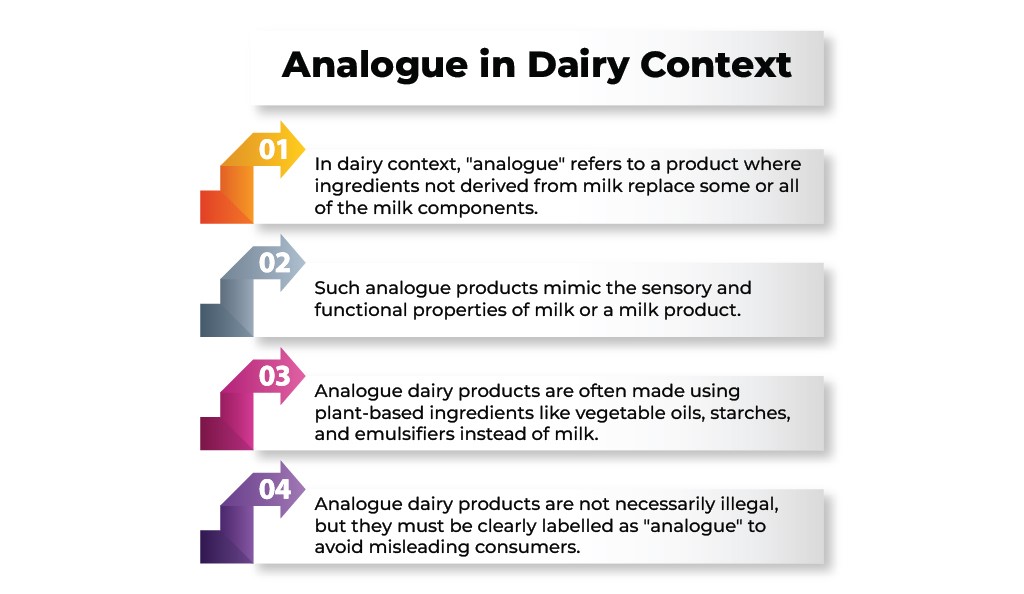
The term “Analogue in dairy context” refers to products in which the constituents are not derived from milk. In these cases, non-milk constituents replace, partially or wholly, milk components, resulting in a product that resembles milk or milk products (which is not milk).
This clarification was to help customers distinguish such products from genuine dairy items, ensuring that they are not mislead.
Regulatory Framework and Labelling Requirements
To maintain transparency and protect consumer interests, FSSAI has established specific labelling requirements for dairy analogues:
| Description | Required Labelling Statement |
| Non-milk constituent replaces a milk component | Contains [name of the constituent including the source] |
| Milk constituent is entirely replaced by a non-milk component | Contains no milk [name of the constituent] |
These guidelines outlined in Sub-regulation 2.1.1 (5), clause (b) of the 2011 Food Safety and Standards (Food Product Standards and Food Additives) Regulations, 2011, are designed to ensure that consumers are fully informed about the nature of the products they purchase.
Regulatory Guidelines on the Use of Dairy Terminology for Non-Dairy Products
The Food Safety and Standards (Food Product Standards and Food Additives) Regulations, 2011, under Sub-regulation 2.1.1(3)(f)(i) and (ii), establish clear rules regarding the use of dairy-related terms for food products that are not derived from milk. These provisions aim to protect consumers from misleading information and ensure transparency in food labelling and marketing.
According to the regulations:
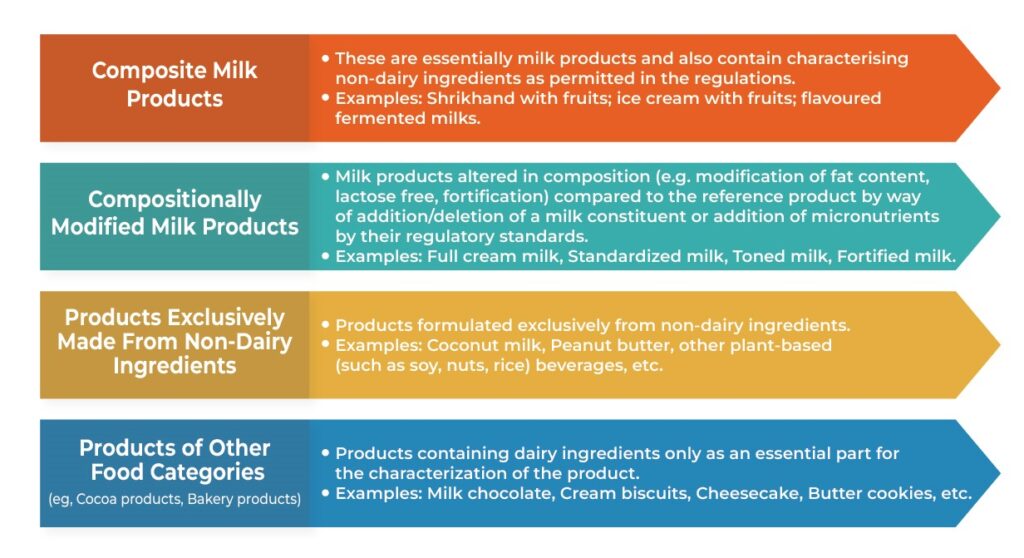
- Classification of Dairy Analogues: Products that imitate milk or milk-based items but are not actually derived from milk (referred to as ‘analogues’) do not qualify as milk, milk products, or composite milk products under these standards.
- Prohibition of Misleading Labels and Advertising: Labels, commercial documents, promotional materials, and any form of point-of-sale communication must not claim, imply, or suggest that a non-dairy product is milk, a milk product, or a composite milk product.
- Restrictions on Dairy Term Usage for Substitutes: Products intended to substitute milk or milk-based products are not permitted to use dairy-specific terminology in any form of marketing, labelling, or presentation.
- Ingredient Listing for Products Containing Dairy Components: If a product contains milk, milk products, or milk constituents that do not fundamentally characterize the product, dairy terms may only be used within the ingredients list. They must not be employed elsewhere for marketing or branding purposes.
These regulations ensure that consumers are not misled about the nature or source of food products. Compliance is mandatory to uphold food safety standards and foster consumer trust.
Invitation for Public Comments
Stakeholders are invited to submit comments, including justifications and supporting examples, on the following proposals:
- Label Terminology for Dairy Analogues:
Suggestions are sought on appropriate labelling terms such as “Non-dairy” or “Analogue” to prefix dairy names when milk constituents are partially or wholly replaced.
- Labelling of Dairy Analogues in Pre-packaged Foods:
When dairy analogues are used in packaged foods, their type must be clearly stated (e.g., Analogue of Cheese), along with a bracketed list of ingredients in descending order.
- Declaration in Food Service Establishments:
Restaurants and caterers must clearly indicate the use of dairy analogues by prefixing terms like “Non-dairy” or “Analogue” on menus or boards to ensure informed consumer choice.
- Prohibition of Loose Sale of Dairy Analogues:
Dairy analogue products should only be sold in sealed packs of at least 500 grams, complying with the labelling standards under the Food Safety Regulations.
- Restriction on FSSAI Registration for Dairy Analogue Manufacturers:
Manufacturers of dairy analogues should not qualify for basic FSSAI registration and must instead obtain a State or Central license to ensure stricter regulatory compliance.
The suggested terminology mentioned in the consultation paper is provisional and will be finalized after further stakeholder consultation.
Conclusion
FSSAI aims to address concerns about the misrepresentation of non-dairy foods as genuine dairy items. Despite existing regulations mandating distinct labelling to differentiate these analogues from authentic dairy products, reports indicate ongoing consumer confusion. To tackle this issue, FSSAI held a stakeholder meeting gathering insights from industry associations, consumer organizations, and Micro, Small, and Medium Enterprises (MSMEs). The authority is now seeking public comments and suggestions on the same.
Short Summary
- On April 16, 2025, FSSAI released a paper discussing “Analogue in Dairy Context” to address the misrepresentation of non-dairy products as dairy items.
- Products mimicking milk or milk-based items, but made from non-milk constituents, must be clearly labelled to avoid misleading consumers.
Recent Posts
How to Manufacture Class A & B Medical Devices in India: State FDA License Guide

A quick guide on the Class A & B Medical Device manufacturing license — covering State FDA rules, Form MD-3/MD-5, fees, and timelines for manufacturers. Every manufacturer entering India’s..
Importing Small Quantities of Cosmetics for R&D in India: NOC Requirements
A brief guide on Cosmetic import NOC India — covering when small quantity Cosmetic import for R&D testing bypasses full registration under Cosmetic rules 2020. Not every Cosmetic shipment into I..
The Cosmeceuticals Grey Zone: When a Cosmetic Claim Risks Becoming a Drug Claim

“Cosmeceutical” is a popular marketing word. It suggests something more powerful than an ordinary Cosmetic — a product that treats skin condition, not just improves appearance. The problem is th..
Get In Touch With Our Team
-
Email: contact@cliniexperts.com
-
Timings: 9 am to 6 pm (Monday to Friday)
-
Location: India: Delhi, Bangalore Global: USA, Singapore