
Table of Contents
How to Apply for CDSCO Medical Device Registration in India: Complete Process (2025 Guide)


Introduction:
As per the Medical Device Rules (MDR), 2017, if you are planning to start manufacturing, importing, or selling medical devices in India one needs to have a valid license. All medical devices that are being sold in India must prove that device are safe and follow the quality and performance regulations along with applicable standards. In India, CDSCO overseas the effectiveness and safety of medical devices are. In this article we will dive into details like SUGAM portal submission, post-approval compliance, device classification, and documentation, this article offers a comprehensive, step-by-step guide on how to apply for CDSCO Medical Device Registration in India.
Understand CDSCO and Its Role
The Central Drugs Standard Control Organization (CDSCO) is India’s national regulatory authority responsible for:
• Issuing licenses for medical devices for manufacturing and import of medical devices
• Ensuring compliance with ISO 13485 quality management standard.
• Managing post-market surveillance.
If your device falls under the notified list, CDSCO registration is mandatory before it can be marketed or imported into India.
Who Needs to Register for CDSCO?
Registration is mandatory for:
· Indian manufacturers that make notified medical devices
· Foreign companies that want to import medical devices into India
· If the Medical device Rules, 2017 say that device has been “notified,” it needs to be registered with the CDSCO.
· Updates from CDSCO as of May 2025
Several changes have been introduced by CDSCO to increase traceability and efficiency:
· Neutral Code for Export: Manufacturers exporting devices can now use a code generated by the system.
· Auto-Generated Compliance Certificates: For licensed entities, market standing and non-conviction certificates can now be produced electronically.
· In-Country Performance Evaluation: Regardless of whether the device has received approval in another country, clinical evaluation in India is required for new in-vitro diagnostic devices (Class B–D).
· The purpose of these improvements is to improve compliance monitoring and transparency, particularly for devices that pose a greater risk.
Steps to register medical device in india:
Step 1: Determine Medical Device Classification
Every medical device must be classified according to risk category under the First Schedule of MDR, 2017:
| Class | Risk Level | Examples |
| Class A | Low Risk | Surgical dressings, thermometers |
| Class B | Low – Moderate Risk | Infusion sets, suction equipment |
| Class C | Moderate-High Risk | Orthopedic implants, cardiac catheters |
| Class D | High Risk | pacemakers |
Note: The higher the class of the device based on risk, the stricter the regulatory requirements and review process they need.
Step 2: Determine Whether the Device Is Notified
In case the device has not been notified, it is also possible to register voluntarily until the notification is received. It is strongly recommended that the device be brought into line with the requirements well before the notification to make a smooth transition for the future period of the enforcement.
Step 3: Find the Correct CDSCO Application Form
Depending on whether one is a manufacturer or importer, and the risk class, different application forms apply:
| Purpose | Applicant | Form | Licensing Authority |
| Manufacturing (Class A/B) | Indian Manufacturer | Form MD-3 | State Licensing Authority (SLA) |
| Manufacturing (Class C/D) | Indian Manufacturer | Form MD-7 | Central Licensing Authority (CLA) |
| Import (All Classes) | Authorized Indian Agent | Form MD-14 | Central Licensing Authority (CLA) |
| Test License | Manufacturer / Importer | Form MD-12 | Central Licensing Authority (CLA) |
| Loan License | Manufacturer | Form MD-4 / Form MD-8 | SLA / CLA |
Step 4: Required Documents
To speed up the approval process one needs a strong, complete technical dossier. Here’s what one needs:
A. Administrative Documents
• Cover letter and undertaking
• ISO 13485:2016 certificate
• Power of Attorney / Authorization letter
• Manufacturing site or import details
• CE/FDA certification (if available)
B. Technical Documents
• Device description and intended use
• Design and manufacturing process
• Risk Management File (ISO 14971)
• Biocompatibility and performance test reports
• Clinical evaluation report or literature summary
• Device labeling and packaging artwork
• Device Master File (DMF) and Plant Master File (PMF)
Step 5: Register on CDSCO SUGAM Portal (if not done already)
All medical device registration applications are submitted online through the SUGAM Portal (https://cdscoonline.gov.in).
Steps:
1. Visit the CDSCO SUGAM Portal.
2. Create an organization profile (Manufacturer/Importer).
3. Upload required documents (authorization letter, ISO certificate, etc.).
4. Once verified, log in and start the application.
Step 6: Submit Application and Pay Fees
• Select the appropriate CDSCO Form (e.g., MD-3, MD-7, MD-14).
• Upload all required documents.
• Pay the government fees online.
Typical CDSCO Fees:
| S. No. | Rule | Type of License | Description | Fee (USD) |
| 1 | 33(1) | Test License to Manufacture | For clinical investigations, testing, evaluation, examination, demonstration, or training for each distinct medical device | $500 |
| 2 | 34(2) | Import License – Class A (other than non-sterile and non-measuring) medical device (other than IVD) | (a) One site | $1000 |
| 3 | 34(2) | (b) Each distinct medical device | $500 | |
| 4 | 34(2) | Import License – Class B medical device (other than IVD) | (a) One site | $2000 |
| 5 | 34(2) | (b) Each distinct medical device | $1000 | |
| 6 | 34(2) | Import License – Class A or B IVD Medical Device | (a) One site | $1000 |
| 7 | 34(2) | (b) Each distinct IVD medical device | $1000 | |
| 8 | 34(2) | Import License – Class C or D Medical Device (other than IVD) | (a) One site | $3000 |
| 9 | 34(2) | (b) Each distinct medical device | $1500 |
Note: Fees may vary; always confirm the latest schedule.)
Step 7: CDSCO Review and Queries
Once submitted, CDSCO or the concerned licensing authority reviews the application. They may raise queries or clarifications related to documents or device details. One must respond promptly to avoid delays. For high-risk devices, site inspections or sample evaluations may occur.
Step 8: Grant of License
If the application is satisfactory, CDSCO issues:
• Manufacturing License (Form MD-5 / MD-9), or
• Import License (Form MD-15)
Licenses are now perpetual, provided retention fees are paid every five years and compliance is maintained.
Step 9: Maintain Post-Market Compliance
After obtaining license, compliance continues through:
• Maintaining ISO 13485 Quality System
• Reporting adverse events
• Notifying any design or site changes to CDSCO
• Renewing retention fees periodically
Failing to maintain compliance can result in license suspension or cancellation.
CDSCO Approval Timelines
| Activity | Estimated Duration |
| SUGAM | Registration 1-2 weeks |
| Application Review | (Class A/B) 4–8 weeks |
| Application Review | (Class C/D) 8–16 weeks |
| License Issuance | 2–3 months |
Summary of CDSCO Registration Process
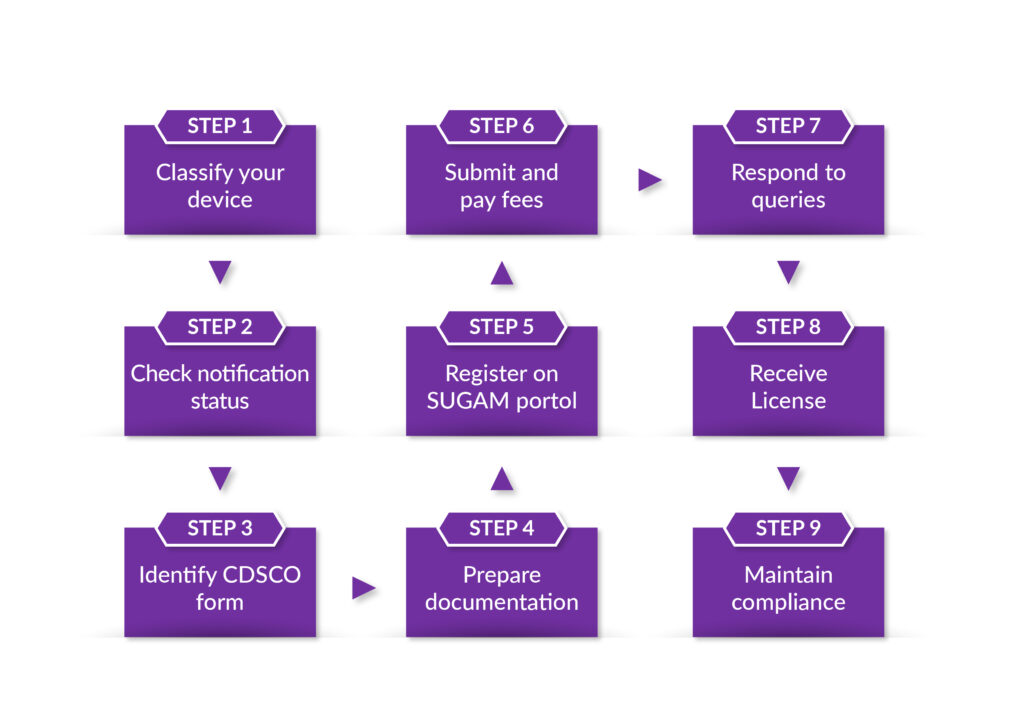
Conclusion
A medical device that needs to be sale and distributed must be registered with CDSCO. CDSCO ensure that the device is safe and effective to use. Understanding the complete process, from classification to documentation and submission, can ensure faster approval and ongoing compliance. If you are someone who is planning to start their own manufacturing unit or want to import devices to India and is not aware with India’s medical device regulations, they can connect to regulatory service provider like CliniExperts who have more than 15+ years of experience and will help expedite the application process, reduce errors, and ensure full compliance with MDR, 2017.
Recent Posts
How to Manufacture Class A & B Medical Devices in India: State FDA License Guide
A quick guide on the Class A & B Medical Device manufacturing license — covering State FDA rules, Form MD-3/MD-5, fees, and timelines for manufacturers. Every manufacturer entering India’s..
Importing Small Quantities of Cosmetics for R&D in India: NOC Requirements
A brief guide on Cosmetic import NOC India — covering when small quantity Cosmetic import for R&D testing bypasses full registration under Cosmetic rules 2020. Not every Cosmetic shipment into I..
The Cosmeceuticals Grey Zone: When a Cosmetic Claim Risks Becoming a Drug Claim

“Cosmeceutical” is a popular marketing word. It suggests something more powerful than an ordinary Cosmetic — a product that treats skin condition, not just improves appearance. The problem is th..
Get In Touch With Our Team
-
Email: contact@cliniexperts.com
-
Timings: 9 am to 6 pm (Monday to Friday)
-
Location: India: Delhi, Bangalore Global: USA, Singapore