
Table of Contents
How to Obtain CDSCO Approval for Biosimilars in India: Complete 2026 Regulatory Pathway


Why India Demands a Dedicated Biosimilar Strategy
India is one of the fastest-growing Biosimilar markets in the world, driven by a large patient population, expanding government healthcare coverage under Ayushman Bharat, and increasing physician acceptance of Biosimilar therapies. For global manufacturers, India represents both a significant commercial opportunity and a regulatory challenge that requires careful preparation.
Unlike small-molecule generics, Biosimilars cannot be approved through simple Bioequivalence studies. The inherent complexity of Biological molecules — their size, three-dimensional structure, and sensitivity to manufacturing conditions — means that the Central Drugs Standard Control Organisation (CDSCO) demands a rigorous comparability exercise before any Biosimilar can be marketed in India.
This article provides a comprehensive overview of India’s 2026 Biosimilar regulatory pathway, including recent updates from the Draft 2025 Similar Biologics Guidelines, and practical guidance for companies preparing their regulatory submissions.
The Regulatory Framework: Similar Biologics Guidelines
India’s primary regulatory framework for Biosimilars is the Guidelines on Similar Biologics: Regulatory Requirements for Marketing Authorization in India, first published in 2012 and subsequently updated. The guidelines were developed by CDSCO and the Department of Biotechnology (DBT) to provide a science-based pathway that balances patient safety with the need to make affordable Biologics accessible to Indian patients.
In 2025, CDSCO released a Draft Update to the Similar Biologics Guidelines, reflecting advances in analytical characterisation science, real-world experience with Biosimilar approvals globally, and lessons from India’s own Biosimilar approval history. Key areas of evolution in the 2025 draft include:
- Greater emphasis on state-of-the-art analytical comparability as the foundation of the Biosimilar dossier
- Updated expectations for immunogenicity assessment, particularly for high-risk Biologics such as monoclonal antibodies (mAbs) and erythropoiesis-stimulating agents
- Refined guidance on extrapolation of indications based on mechanism of action and totality of evidence
- Clarified expectations for post-marketing commitments, including Pharmacovigilance and risk management
Companies preparing submissions in 2026 should ensure their regulatory strategy reflects both the existing guidelines and the direction signaled in the 2025 draft, as CDSCO reviewers are expected to apply emerging scientific standards even before formal gazette notification.
Step-by-Step: The CDSCO Biosimilar Approval Pathway
Step 1: Reference Biologic Selection
The foundation of any Biosimilar programmed is the selection of the appropriate Reference Biologic (RB). For India submissions, the RB must either be the innovator product approved in India or — with adequate scientific justification — a product approved in a stringent regulatory authority (SRA) jurisdiction such as the US, EU, or Japan. CDSCO has shown increasing openness to SRA-approved reference products, particularly for molecules where the Indian innovator brand has limited market data.
Step 2: Analytical Comparability (Physicochemical and Biological)
This is the cornerstone of the Biosimilar dossier. CDSCO expects an extensive head-to-head characterisation exercise between the proposed Biosimilar and the reference biologic. Key assessments include:
- Primary structure: amino acid sequence confirmation, glycosylation profiling, and desulphated bond mapping
- Higher-order structure: secondary and tertiary structural analysis using circular dichroism (CD) and nuclear magnetic resonance (NMR) where applicable
- Biological activity: potency assays, receptor binding studies, and Fc effector function assessments for mAbs
- Purity and impurity profiles: host cell proteins (HCPs), host cell DNA, and process-related impurities
The analytical package must be built on a statistically robust comparison using multiple batches of both the reference and proposed Biosimilar. Single-batch comparisons are not acceptable to CDSCO.
Step 3: Non-Clinical Studies
If residual uncertainty remains after analytical comparability, CDSCO may require Non-Clinical (in vitro or in vivo) bridging studies. The extent of Non-Clinical data required is inversely proportional to the robustness of the analytical package. Companies that invest in comprehensive analytical characterisation can often reduce the non-clinical burden significantly.
Step 4: Clinical Bridging Studies
For most Biosimilar programmes, clinical bridging studies are required. CDSCO expects:
- Phase I pharmacokinetic (PK) and pharmacodynamic (PD) equivalence studies, typically in healthy volunteers for relatively safe molecules or in relevant patient populations for higher-risk biologics
- Phase III efficacy and safety confirmation studies, the scope of which depends on the level of analytical and non-clinical similarity established
- For monoclonal antibodies targeting immunological conditions, CDSCO generally requires confirmatory clinical data in at least one indication before extrapolation to others is permitted
Step 5: Scientific Expert Committee (SEC) Interaction
One of the most strategically important steps in India’s Biosimilar approval process is the Scientific Expert Committee (SEC) meeting. Unlike some other jurisdictions, CDSCO convenes an expert panel to review Biosimilar applications, and their recommendations carry significant weight in the approval decision.
Companies should prepare thoroughly for SEC interactions, including:
- A clear totality of evidence narrative that connects analytical, non-clinical, and Clinical data packages
- Prepared responses to likely questions on immunogenicity, extrapolation justification, and post-marketing commitments
- Well-structured presentations that help committee members quickly grasp the scientific rationale
Experienced regulatory professionals who have previously appeared before Indian SEC panels can significantly improve the quality and outcome of these interactions.
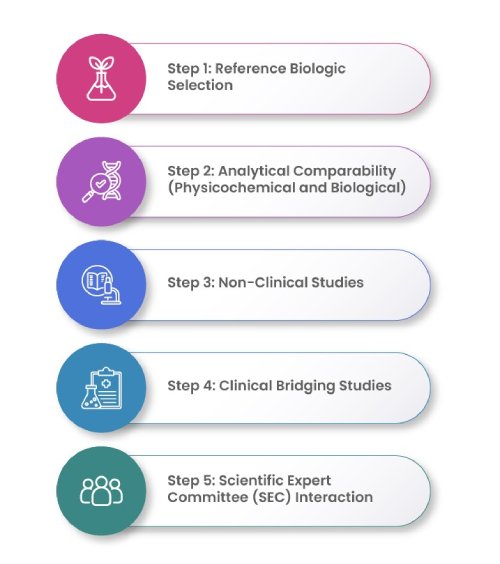
Figure1
Importer vs. Indian Manufacturer: Key Pathway Differences
The regulatory pathway for Biosimilars differs importantly depending on whether the applicant is a foreign manufacturer importing finished product or an Indian company manufacturing locally.
Foreign importers must obtain import registration under the Drugs and Cosmetics Act and must appoint an authorised Indian agent. The clinical data package expected is generally the same, but importers may face additional scrutiny on supply chain continuity, cold chain capability, and post-marketing pharmacovigilance infrastructure.
Indian manufacturers — particularly those under the Make in India umbrella — may benefit from expedited review timelines and may have access to certain government incentive programmes, but they must demonstrate compliance with Schedule M GMP requirements and, for recombinant biologics, RCGM approval for the manufacturing facility.
Common Pitfalls and How to Avoid Them
- Insufficient reference biologic batches: Using fewer than 10 batches of the reference biologic for the analytical comparability study is a frequent deficiency. CDSCO expects statistically meaningful data.
- Weak immunogenicity programme: Applicants from markets with lower regulatory expectations on immunogenicity often submit programmes that fall short of CDSCO’s expectations, particularly for high-risk biologics.
- Underestimating SEC preparation: Treating the SEC meeting as a formality rather than a pivotal regulatory event leads to missed opportunities and delayed approvals.
- Ignoring local labelling requirements: India has specific labelling requirements for biologics, including mandatory statements in Hindi and local adverse event reporting instructions.
Estimated Timelines
Companies should budget 24 to 36 months from the initiation of analytical comparability studies to marketing approval, assuming a well-prepared dossier and no major deficiency of letters. Companies with prior approval from SRA jurisdictions and a strong analytical package can sometimes achieve approval at the lower end of this range.
Conclusion
India’s Biosimilar regulatory pathway is science-driven, multi-step, and requires deep expertise in both CDSCO’s expectations and the rapidly evolving science of biological characterisation. Companies that invest in regulatory intelligence, rigorous analytical programmes, and experienced SEC preparation will be best positioned to achieve timely approvals and build durable commercial positions in one of the world’s most important biologics markets.
Ready to navigate India’s biologicals regulatory landscape? CliniExperts Services brings deep expertise across CDSCO, RCGM, DBT, and NIB pathways. Contact us contact@cliniexperts.com for a complimentary regulatory feasibility assessment
Recent Posts
How to Manufacture Class A & B Medical Devices in India: State FDA License Guide
A quick guide on the Class A & B Medical Device manufacturing license — covering State FDA rules, Form MD-3/MD-5, fees, and timelines for manufacturers. Every manufacturer entering India’s..
Importing Small Quantities of Cosmetics for R&D in India: NOC Requirements
A brief guide on Cosmetic import NOC India — covering when small quantity Cosmetic import for R&D testing bypasses full registration under Cosmetic rules 2020. Not every Cosmetic shipment into I..
The Cosmeceuticals Grey Zone: When a Cosmetic Claim Risks Becoming a Drug Claim

“Cosmeceutical” is a popular marketing word. It suggests something more powerful than an ordinary Cosmetic — a product that treats skin condition, not just improves appearance. The problem is th..
Get In Touch With Our Team
-
Email: contact@cliniexperts.com
-
Timings: 9 am to 6 pm (Monday to Friday)
-
Location: India: Delhi, Bangalore Global: USA, Singapore