
Table of Contents
Loan License vs Own Manufacturing License in India: Which Route Is Right for Your Medical Device Business?


One of the most consequential decisions a Medical Device company faces when entering the Indian manufacturing landscape is whether to establish its own licensed manufacturing facility or to operate under a loan license arrangement. Both routes are fully legitimate under India’s Medical Devices Rules, 2017 (MDR 2017), and each carry distinct regulatory, financial, and operational implications.
Before applying for either a manufacturing license or a loan license, it is important to understand that the eligibility criteria and Regulatory expectations differ for each pathway.
This article provides a comprehensive, side-by-side analysis of the two models to help companies make an informed decision aligned with their business strategy, product pipeline, and long-term India ambitions.
Understanding the Two Models
Own Manufacturing License
A Manufacturing License authorizes a company to manufacture Medical Devices at its own approved facility, in compliance with the requirements of India’s Medical Devices Rules, 2017 (MDR 2017). Under this model, the company is responsible for establishing and maintaining its own infrastructure, quality management system, and Regulatory Compliance, and it manufactures and markets the product under its own name.
A manufacturing license — applied for through MD-3 (Class A/B) or MD-7 (Class C/D) — means your company establishes and operates its own manufacturing facility in India. The license is held in your company’s name, and you are fully responsible for the facility, the manufacturing process, the quality management system, and regulatory compliance.
Loan License
A Loan License permits a company to manufacture its Medical Devices using the facilities of another licensed manufacturer, while marketing the products under its own brand. This model is particularly useful for startups, importers, healthcare companies, and brand owners who want market access without investing in their own manufacturing infrastructure.
Simply put:
- Company A owns a licensed manufacturing facility.
- Company B intends to sell Medical Devices under its own brand name.
- Instead of setting up a factory, Company B uses Company A’s facility for production.
- Company B obtains a Loan License from CDSCO to operate under this arrangement.
A loan license — applied for through MD-4 (Class A/B) or MD-8 (Class C/D) — allows your company to manufacture products using the premises, plant, equipment, and technical staff of a licensed manufacturer (the licensor). You hold the Regulatory license in your own name and take responsibility for the product, but the physical manufacturing is carried out at a third-party facility.
Comparative Analysis
| Factor | Own Manufacturing License | Loan License |
|---|---|---|
| Capital investment | High — facility construction, equipment, utilities, and QMS build-out | Low to moderate — no facility capital required |
| Time to first production | Longer — facility setup, inspection, and licensing (12–24 months) | Faster — 4–9 months once licensor arrangement is in place |
| Regulatory control | Full control over all processes, SOPs, and QMS | Shared — dependent on licensor’s facility standards |
| Scalability | High — full ownership of manufacturing capacity | Limited — constrained by licensor’s available capacity |
| Flexibility | Less flexible — tied to a fixed facility | More flexible — can switch licensors or diversify products more easily |
| IP and trade secret risk | Lower — no external access to processes or formulations | Higher — licensor may have visibility into formulations and processes |
| Ongoing compliance | Full responsibility — all inspections and QMS maintenance managed in-house | Shared — licensor ensures facility compliance; licensee responsible for product compliance |
| Recommended for | Established companies with committed India pipeline and long-term volume strategy | Startups, SMEs, and foreign companies testing or entering the India market |
Table1
When the Loan License Route Makes Strategic Sense
The loan license model is particularly well suited to the following scenarios:
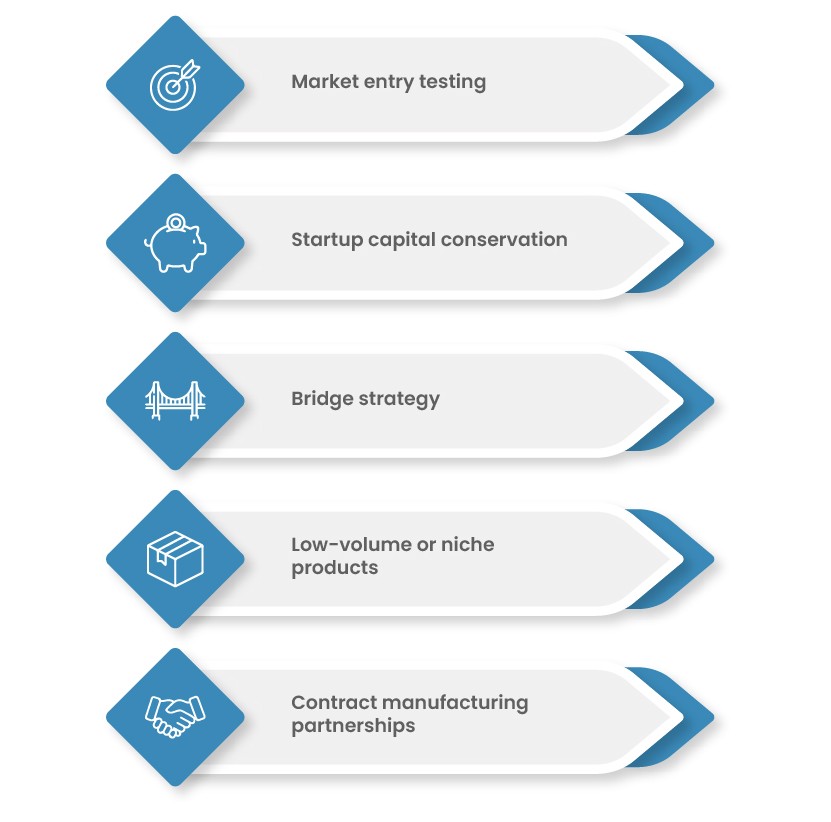
- Market entry testing: A foreign MedTech company wants to manufacture and sell in India before committing to a greenfield facility investment
- Startup capital conservation: An early-stage Indian MedTech company aims to launch a product while preserving capital for R&D and commercialisation
- Bridge strategy: A company plans to establish its own facility long-term but needs to generate revenue while construction and approvals are underway
- Low-volume or niche products: Products with limited demand that do not justify the capital investment required for a dedicated manufacturing facility
- Contract manufacturing partnerships: Situations where an established relationship with a licensed manufacturer ensures quality, reliability, and faster execution
A well-structured loan license agreement is critical. The agreement must clearly define product ownership, batch release authority, quality responsibilities, IP protection, exclusivity terms, and dispute resolution mechanisms. CDSCO expects this agreement to be robust and legally sound.
Regulatory Considerations Specific to Loan Licenses
Several Regulatory nuances are important to understand before choosing the loan license route:
- The loan licensee holds the license and bears full Regulatory responsibility for product safety and compliance — including post-market surveillance and vigilance reporting
- The licensor’s manufacturing license must cover the same device class and type of product being manufactured under the loan arrangement
- CDSCO or the SLA will inspect both the licensor’s facility and verify the loan agreement during the application process
- Any change in the licensor (i.e., switching to a different manufacturing partner) requires regulatory notification and may require a fresh application
- The loan licensee’s name and address must appear on the product label alongside the licensor’s site details
Transitioning from Loan License to Own License
Many successful Indian Medtech companies begin with a loan license and transition to their own manufacturing facility once revenue and volume justify the investment. This is a well-recognised strategic pathway. Key considerations when planning this transition:
- Begin facility planning and site selection early — approval timelines for own manufacturing licenses are 12–18 months for Class C/D
- Use the loan license period to build your QMS, technical team, and Regulatory track record
- Maintain good relationships with your licensor — you may need their capacity while your own facility is being approved
- Budget for parallel running costs: both the loan license and the own facility approval process overlap during the transition period
Conclusion
The decision between a loan license and an own manufacturing license is not binary or permanent it is a strategic choice that should evolve with the company’s growth.
- For companies entering the Indian market, a loan license offers a faster, lower-risk pathway with reduced upfront investment.
- For companies with established demand and long-term strategic commitment, an own manufacturing license provides greater control, scalability, and stronger IP protection.
A phased approach—starting with a loan license and transitioning to an owned facility—is often the most practical and commercially efficient pathway for many MedTech companies.

Saurangi is a food regulatory expert with 8 years of experience. She shares her knowledge and insights on regulatory updates, food trends, best practices, and news. Follow her for expert insights and practical advice on all things for food regulatory
Saurangi Shah
CliniExperts Services Pvt. Ltd.
Recent Posts
How to Manufacture Class A & B Medical Devices in India: State FDA License Guide
A quick guide on the Class A & B Medical Device manufacturing license — covering State FDA rules, Form MD-3/MD-5, fees, and timelines for manufacturers. Every manufacturer entering India’s..
Importing Small Quantities of Cosmetics for R&D in India: NOC Requirements
A brief guide on Cosmetic import NOC India — covering when small quantity Cosmetic import for R&D testing bypasses full registration under Cosmetic rules 2020. Not every Cosmetic shipment into I..
The Cosmeceuticals Grey Zone: When a Cosmetic Claim Risks Becoming a Drug Claim

“Cosmeceutical” is a popular marketing word. It suggests something more powerful than an ordinary Cosmetic — a product that treats skin condition, not just improves appearance. The problem is th..
Get In Touch With Our Team
-
Email: contact@cliniexperts.com
-
Timings: 9 am to 6 pm (Monday to Friday)
-
Location: India: Delhi, Bangalore Global: USA, Singapore