
Table of Contents
Pharmacovigilance Regulations For Imported Drugs In India


Pharmacovigilance ensures that Drugs are continuously monitored for safety, quality, and efficacy through structured reporting systems and regulatory oversight mechanisms post-approval. In India, the pharmacovigilance regulations for imported Drugs are overseen by CDSCO.
India’s regulatory authority, CDSCO, mandates stringent Pharmacovigilance practices to detect, assess, and prevent adverse Drug reactions, thereby ensuring patient safety across all Imported Pharmaceutical products.
Pharmacovigilance Regulatory Framework In India (CDSCO)
The Central Drugs Standard Control Organization (CDSCO) governs Pharmacovigilance regulatory framework activities under the Drugs and Cosmetics Act and the New Drugs and Clinical Trial Rules.
Marketing Authorization Holders (MAHs) Importing Drugs must comply with Indian Pharmacovigilance guidelines and coordinate with the Pharmacovigilance Programme of India (PvPI).
This framework ensures that global safety data is integrated with local monitoring systems.
ADR Reporting In India: Key Requirements
Adverse Drug Reaction (ADR) reporting is a critical obligation for imported drug manufacturers and MAHs.
All suspected adverse Drug reactions must be reported to CDSCO and PvPI within specified timelines, depending on severity.
Key ADR Reporting Obligations
- Report serious adverse events within 15 calendar days
- Submit non-serious ADRs periodically
- Maintain detailed case records
- Ensure traceability of Imported Drug batches
- Report signals emerging from global safety data
These requirements strengthen adverse Drug reaction reporting practices and ensure timely regulatory intervention.
PSUR Reporting in India for Imported Drugs
Periodic Safety Update Reports (PSURs) are essential for ongoing safety evaluation.
Under PSUR reporting requirements, MAHs must submit safety summaries at defined intervals after Drug approval.
| Period After Approval | Frequency of Submission |
| First 2 years | Every 6 months |
| Next 2 years | Annually |
| Thereafter | As required by CDSCO |
Table 1: PSUR Reporting Timelines in India
PSURs must include global and local safety data, benefit-risk evaluation, and regulatory actions taken in other countries.
Drug Safety Monitoring in India: Role of MAHs
Drug safety monitoring requires MAHs to establish robust Pharmacovigilance systems.This includes appointing a Qualified Person for Pharmacovigilance (QPPV) or equivalent responsible for safety reporting and compliance.
Core Pharmacovigilance Responsibilities
- Continuous safety data collection
- Signal detection and risk evaluation
- Submission of safety reports to CDSCO
- Coordination with global Pharmacovigilance teams
- Implementation of risk minimization measures
These measures ensure that Imported Drugs remain safe throughout their lifecycle.
Post Marketing Surveillance in India for Imported Drugs
Post marketing surveillance plays a vital role in identifying rare or long-term adverse effects not detected during drug clinical trials.Imported Drugs must undergo continuous monitoring through spontaneous reporting systems and active surveillance programs.
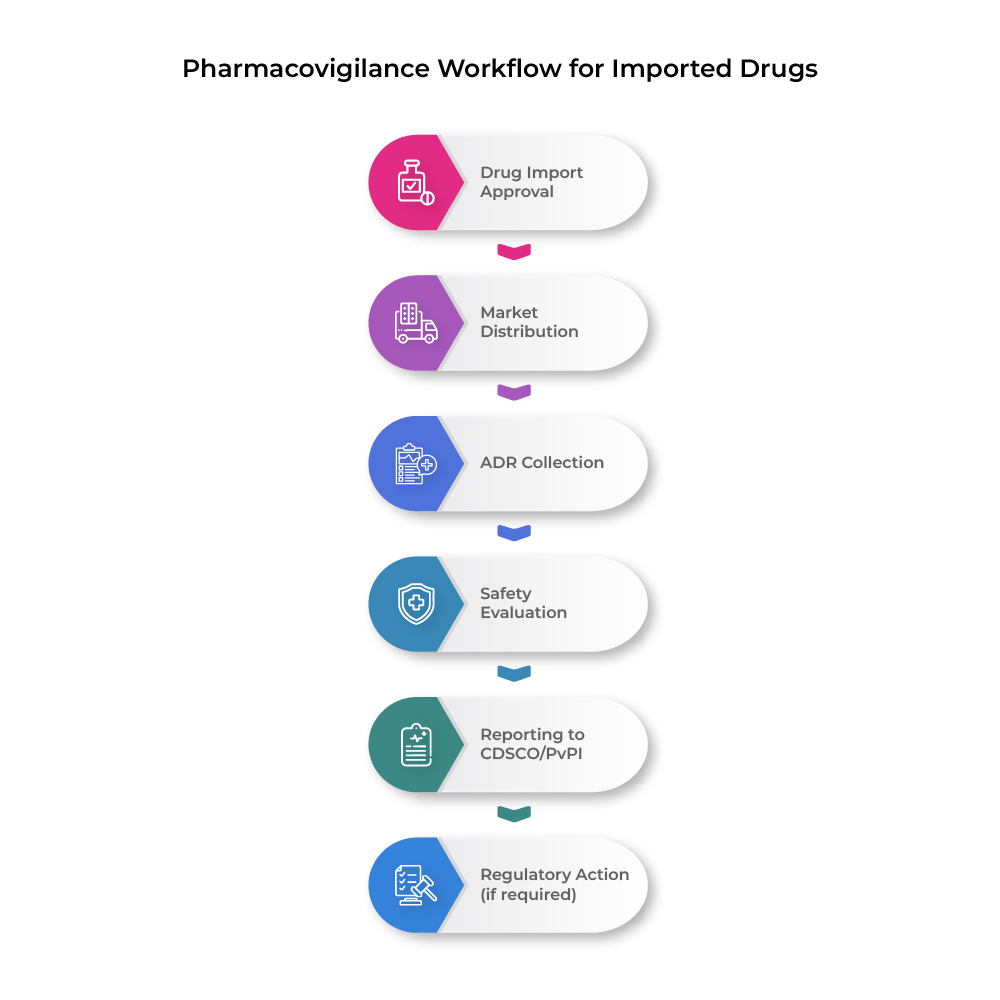
Figure 1
CDSCO Inspection and Compliance Expectations
CDSCO may conduct inspections to verify Pharmacovigilance compliance for Imported Drugs. Companies must maintain documentation and demonstrate adherence to reporting timelines and procedures.
Key Compliance Areas
- Record maintenance of ADR cases
- PSUR submission records
- Standard Operating Procedures (SOPs)
- Training in pharmacovigilance personnel
- Audit readiness
Failure to comply may result in regulatory action, including warnings, suspension, or license cancellation.
Challenges in Pharmacovigilance Regulations for Imported Drugs
Managing Pharmacovigilance for Imported Drugs involves coordination across global and local systems.
Differences in reporting timelines, data formats, and regulatory expectations can pose challenges for MAHs.
However, harmonized practices and digital reporting tools are improving efficiency and compliance.
Conclusion
The Pharmacovigilance system in India ensures continuous monitoring of Imported Drugs, safeguarding public health.
Summary Points
- Pharmacovigilance India CDSCO mandates strict safety monitoring
- ADR reporting India Drugs requires timely submission of adverse events
- PSUR reporting India ensures periodic safety evaluation
- Drug safety monitoring India involves continuous risk assessment
- Post marketing surveillance detects long-term safety issues
- CDSCO inspections enforce compliance and accountability
In conclusion, effective compliance with CDSCO Pharmacovigilance requirements is essential for maintaining Drug safety, regulatory approval, and public trust in Imported Pharmaceutical products.
Recent Posts
How to Manufacture Class A & B Medical Devices in India: State FDA License Guide
A quick guide on the Class A & B Medical Device manufacturing license — covering State FDA rules, Form MD-3/MD-5, fees, and timelines for manufacturers. Every manufacturer entering India’s..
Importing Small Quantities of Cosmetics for R&D in India: NOC Requirements
A brief guide on Cosmetic import NOC India — covering when small quantity Cosmetic import for R&D testing bypasses full registration under Cosmetic rules 2020. Not every Cosmetic shipment into I..
The Cosmeceuticals Grey Zone: When a Cosmetic Claim Risks Becoming a Drug Claim

“Cosmeceutical” is a popular marketing word. It suggests something more powerful than an ordinary Cosmetic — a product that treats skin condition, not just improves appearance. The problem is th..
Get In Touch With Our Team
-
Email: contact@cliniexperts.com
-
Timings: 9 am to 6 pm (Monday to Friday)
-
Location: India: Delhi, Bangalore Global: USA, Singapore