
Table of Contents
Post-Market Surveillance and Pharmacovigilance Compliance Under India’s PvPI Framework


A practical guide to post-market surveillance obligations, adverse event reporting timelines, PSUR filings, and CDSCO enforcement trends under India’s PvPI framework.
Getting a Drug approved in India is only half the journey. Post-market surveillance and Pharmacovigilance compliance under India’s PvPI framework continue for the entire lifecycle of the product, not just at launch.
Understanding Post-Market Surveillance and Pharmacovigilance Compliance Under PvPI
Once a Drug enters the Indian market, the Marketing Authorisation Holder (MAH) becomes responsible for tracking every safety signal reported by patients, doctors, and pharmacists.
The Pharmacovigilance Programme of India (PvPI), coordinated by the Indian Pharmacopoeia Commission under CDSCO (ADRMS Made Easy: A Step-by-Step Guide to Medical Device Adverse Event Reporting under Materiovigilance Programme of India – Indian Pharmacopoeia Commission), forms the backbone of this ongoing monitoring system.
Unlike the one-time approval process, Pharmacovigilance is continuous. It demands dedicated systems, trained personnel, and disciplined documentation long after the license is granted.
Adverse Event Reporting Timelines Under the PvPI Framework
Timely reporting is the core requirement of India’s Pharmacovigilance system. Delays or missed submissions are among the most common compliance failures companies face.
Key reporting timelines under PvPI include:
- Serious Adverse Events (SAEs) occurring in India must be reported within 15 to 24 hours of awareness, depending on severity
- Non-serious adverse events are generally compiled and reported within 15 calendar days
- Adverse Events of Special Interest (AESIs) often require expedited reporting similar to SAEs
- Death or life-threatening cases require immediate initial reporting, followed by a detailed follow-up report
- Annual and periodic summaries must reconcile all cases reported during the interval
Missing these windows can trigger regulatory queries, warning letters, or deeper CDSCO scrutiny of the entire safety system.
Periodic Safety Update Reports and PvPI Documentation Requirements
Periodic Safety Update Reports (PSURs) give CDSCO a consolidated view of a Drug’s safety profile over defined intervals after approval.
Typical PSUR obligations include:
- Filing every six months for the first two years after a New Drug’s approval in India
- Shifting to annual filing thereafter, unless CDSCO specifies otherwise for high-risk products
- Including cumulative case data, signal evaluation, and any label changes made globally or locally
- Submitting Risk Management Plans (RMPs) alongside PSURs where applicable
- Maintaining audit-ready documentation trails for at least the retention period specified by CDSCO
Reporting Timelines and PSUR Filing Snapshot
| Requirement | Trigger | Timeline |
| Serious Adverse Event (SAE) | Death or life-threatening case | 15–24 hours |
| Non-serious adverse event | Routine case detection | 15 calendar days |
| PSUR (early phase) | First 2 years post-approval | Every 6 months |
| PSUR (later phase) | After 2 years | Annually |
| Risk Management Plan update | New safety signal | As specified by CDSCO |
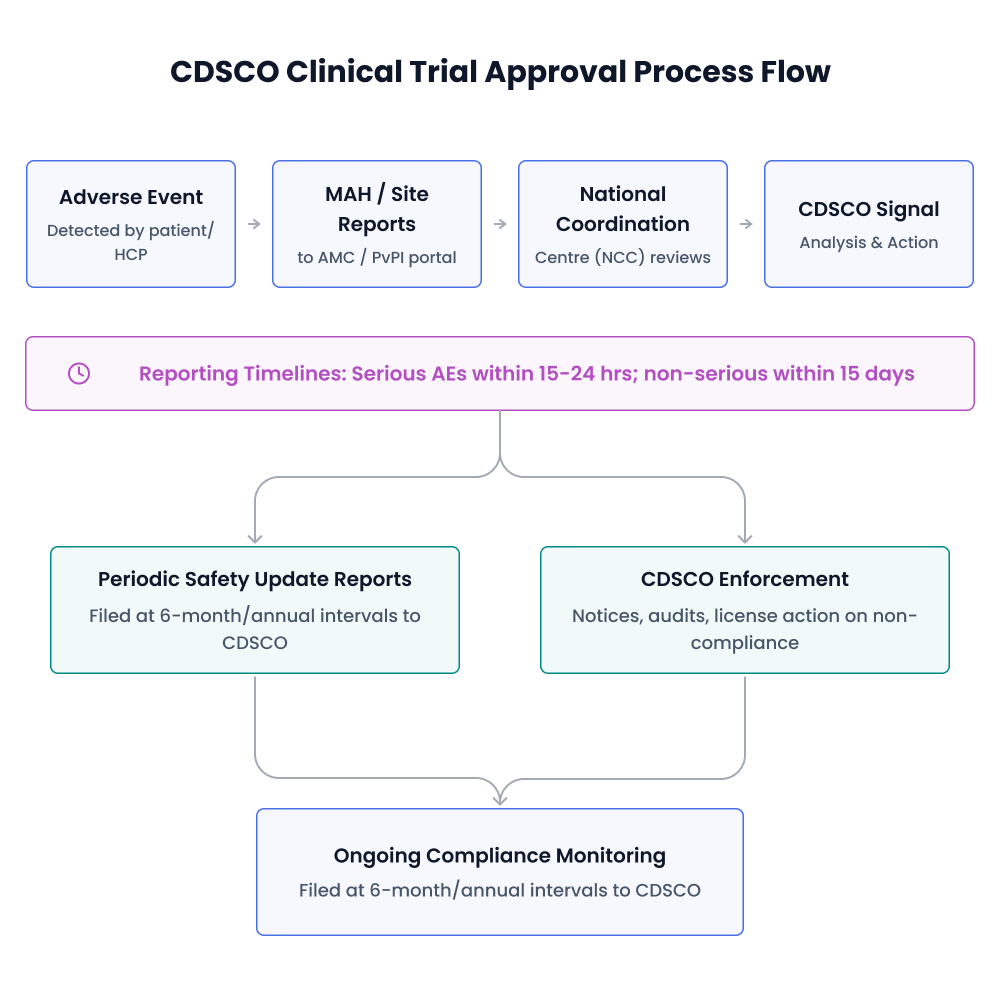
Figure 1
Recent CDSCO Enforcement Trends in Pharmacovigilance
CDSCO has visibly tightened oversight of Pharmacovigilance compliance in recent years, moving beyond approval-stage checks toward continuous market surveillance.
Observable enforcement trends include:
- More frequent audits of MAH Pharmacovigilance systems, including document trails and SOP adherence
- Increased scrutiny of PSUR submission consistency across multiple approved products
- Greater coordination between state licensing authorities and central CDSCO for non-compliance action
- Rising use of show-cause notices before license suspension, giving companies a narrow compliance window
- Growing expectation that companies maintain qualified persons for pharmacovigilance within India
These trends signal that pharmacovigilance is no longer a background formality but a front-line regulatory priority.
Why Long-Term Compliance Partnership Matters
Many companies treat regulatory consultants as a one-time approval resource, then manage Pharmacovigilance internally with limited bandwidth or expertise.
This gap often shows up years later, when a missed PSUR deadline or delayed SAE report draws CDSCO attention during a routine audit or product renewal cycle.
CliniExperts positions itself differently: as a long-term compliance partner supporting Pharmacovigilance obligations continuously, not merely a consultant engaged only for the initial approval stage.
A sustained partnership helps companies build internal PvPI-aligned systems, track evolving CDSCO expectations, and respond promptly to enforcement actions before they escalate.
Conclusion
- Post-market surveillance and Pharmacovigilance compliance under India’s PvPI framework apply for the entire lifecycle of an approved Drug, and CliniExperts helps companies stay compliant throughout
- Serious adverse events must be reported within 15–24 hours and non-serious events within 15 days; CliniExperts helps set up systems that consistently meet these windows
- PSURs are due every six months for the first two years, then annually thereafter, and CliniExperts supports accurate, on-time compilation and filing of each report
- CDSCO enforcement has grown stricter, with more audits and quicker escalation to show-cause notices, and CliniExperts helps companies prepare for and respond to these actions
- Partnering with CliniExperts as a long-term compliance partner, rather than a one-time approval-stage consultant, helps companies stay audit-ready well beyond initial market entry
Recent Posts
How to Manufacture Class A & B Medical Devices in India: State FDA License Guide
A quick guide on the Class A & B Medical Device manufacturing license — covering State FDA rules, Form MD-3/MD-5, fees, and timelines for manufacturers. Every manufacturer entering India’s..
Importing Small Quantities of Cosmetics for R&D in India: NOC Requirements
A brief guide on Cosmetic import NOC India — covering when small quantity Cosmetic import for R&D testing bypasses full registration under Cosmetic rules 2020. Not every Cosmetic shipment into I..
The Cosmeceuticals Grey Zone: When a Cosmetic Claim Risks Becoming a Drug Claim

“Cosmeceutical” is a popular marketing word. It suggests something more powerful than an ordinary Cosmetic — a product that treats skin condition, not just improves appearance. The problem is th..
Get In Touch With Our Team
-
Email: contact@cliniexperts.com
-
Timings: 9 am to 6 pm (Monday to Friday)
-
Location: India: Delhi, Bangalore Global: USA, Singapore