
Table of Contents
The Complete Roadmap to Cosmetic Import Registration in India



India’s Cosmetic Market and Why Registration Matters
India’s Cosmetic and personal care market has grown into one of the most consequential in the Asia-Pacific region — valued at over USD 6 billion and expanding at a compound annual growth rate that consistently outpaces global averages. For a global Cosmetic brand, India is no longer a peripheral market. It is a strategic priority.
Yet for all its commercial appeal, entering India with a Cosmetic product requires clearing a structured regulatory process overseen by the Central Drugs Standard Control Organisation (CDSCO). The cornerstone of that process is the Import Registration Certificate — issued through Form COS-2 following an application in Form COS-1.
This article provides a complete, practitioner-grade walkthrough of that process: who can apply, what documents are required, how the SUGAM portal works, what the statutory timelines look like, and the critical tips that determine whether your application sails through or stalls at the query stage.
The Regulatory Framework: Cosmetics Rules 2020
Cosmetic imports into India are governed by the Drugs and Cosmetics Act, 1940 and the Cosmetics Rules, 2020 — a significantly modernised framework that replaced the older Drugs and Cosmetics Rules, 1945 provisions relating to Cosmetics. The 2020 Rules streamlined the application process, introduced online filing via the SUGAM portal, and codified timelines for regulatory decision-making.
Under this framework, CDSCO — specifically the Drugs Controller General (India), or DCGI — is the authority that grants import registration certificates for Cosmetics. No Cosmetic product may be imported into India for the purpose of sale or distribution without a valid COS-2 registration certificate.
Who Can Apply for COS-2?
The Cosmetics Rules 2020 specify four categories of eligible applicants for Cosmetic import registration:
- The manufacturer of the Cosmetic product
- The authorised agent of the manufacturer based in India
- The importer of the Cosmetic product in India
- An Indian subsidiary of the manufacturer, where the manufacturer has authorised the subsidiary
In practice, most global brands entering India for the first time appoint an authorised agent — a company like CliniExperts that holds no commercial interest (no distribution, no marketing, no sales) in the product. This separation of regulatory responsibility from commercial activity is not just a regulatory convenience; it is a compliance requirement Many global brands appoint an authorised agent in India to manage regulatory submissions and liaison with CDSCO
The SUGAM Portal: Your Digital Gateway to CDSCO
All Cosmetic import registration applications must be submitted through the SUGAM online portal — CDSCO’s centralised digital platform for regulatory submissions. Before any application can be filed, the applicant (whether importer, authorised agent, or manufacturer’s Indian entity) must complete their registration on the SUGAM portal.
Portal registration requires basic entity information, contact details, and the establishment of login credentials. Once registered, the portal enables applicants to initiate new applications, upload supporting documents, pay government fees, and track application status in real time.
A common early mistake is rushing into the application without completing the portal registration properly. An incomplete or incorrectly configured SUGAM account can cause downstream problems at the document upload or fee payment stage, resulting in avoidable delays.
Form COS-1: The Application Form
Form COS-1 is the application form through which an applicant seeks an import registration certificate. It is a structured document that captures:
- Details of the applicant (importer, authorised agent, or manufacturer’s entity in India)
- Details of the foreign manufacturer — name, address, and manufacturing premises
- Description of the Cosmetic product — including brand name, generic product name, category, and product type
- Pack sizes and their variants
- Formulation details and ingredient list
- Declaration of compliance with Indian labelling and ingredient regulations
Form COS-1 is generated and filled online through the SUGAM portal. Once all information is entered and required documents are attached, the applicant generates a system-produced COS-1, prints it, obtains the authorised signatory’s signature and company stamp, scans it, and uploads the signed version back into the portal.
This signed COS-1 — along with all supporting documents and the fee payment challan — constitutes the complete application package.
Required Documents: The Complete Checklist
The following documents are mandatory for a COS-2 application:
- Authorization letter from the foreign manufacturer appointing the applicant as their authorised representative/agent in India. Authorization letters generally require apostille/legalization depending on country of origin.
- Product formulation — ingredient list with INCI names, concentrations, CAS no., function of each ingredient
- Specification Sheet for the finished product
- Free Sale Certificate (FSC) — issued by the competent authority in the country of manufacture, confirming the product is freely sold in that country, further require apostille/legalization depending on country of origin.
- Product label (inner and outer packaging) — must comply with Rule 34 of Cosmetics Rules 2020
- Testing method document — analytical methods used to test the product
- Heavy metal declaration — Heavy metal declaration confirming compliance with permissible limits prescribed under the Cosmetics Rules and relevant BIS standards
- Additional declarations as applicable: Shelf Life declaration, SPF report.
All documents must be in English. Documents in other languages must be accompanied by a certified English translation.
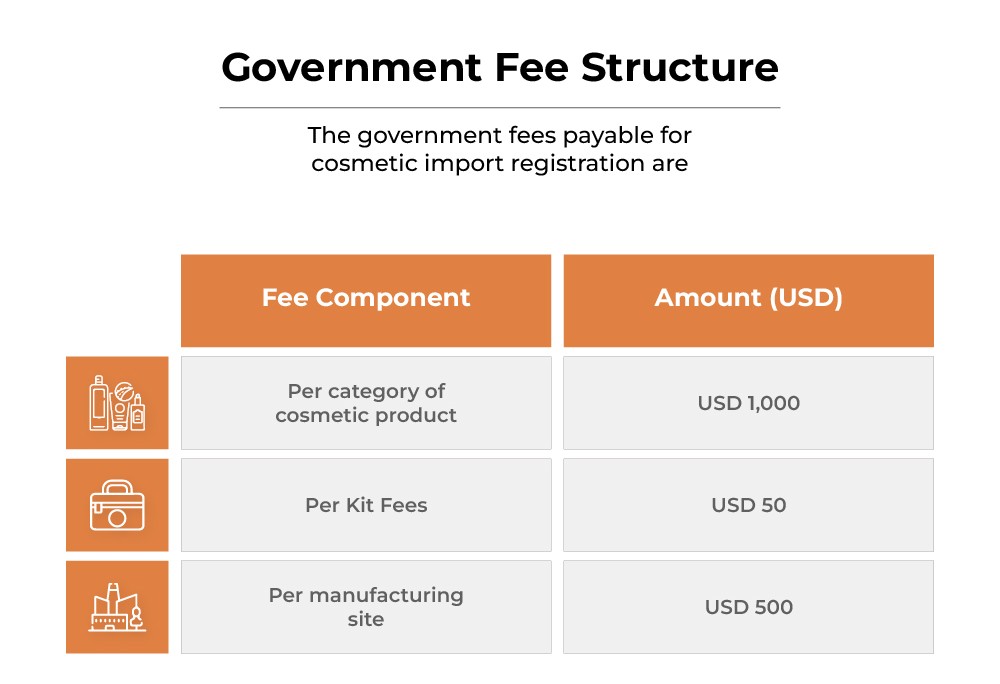
Fees are paid online through the SUGAM portal. A challan confirming payment — including the amount paid and the applicant’s details — must be generated and uploaded as part of the application. Underpayment is a common cause of deficiency letters and application stalling.
The Statutory Timeline: 180 Working Days
The Cosmetics Rules 2020 stipulate a statutory review timeline of 180 working days from the date of complete and valid application submission. This is the government’s committed processing window for issuing a COS-2 — or raising queries.
In practice, the 180-day clock is reset each time CDSCO raises a query and the applicant provides additional information. It is therefore entirely possible for an application to extend well beyond 180 working days if multiple query rounds occur. This makes front-end application quality — correct categorisation, complete documentation, BIS-compliant formulation — the single most important determinant of actual approval timeline.
An application that is submitted complete and compliant on the first attempt will typically receive its COS-2 registration certificate within 6 to 9 months from the date of filing.
Form COS-2: The Registration Certificate
COS-2 is the Import Registration Certificate issued by CDSCO upon successful review and approval of the COS-1 application. It is the document that authorises the holder to import and market the registered Cosmetic product in India.
The COS-2 certificate must be produced by the authorised importer, distributor, or authorised agent as and when required by the licensing authority — at Customs, during market surveillance inspections, or upon request from State Licensing Authorities.
Validity: Five years from the date of issue.
Renewal: The holder must initiate the retention/renewal process well before expiry. (See Article 9 of this series for the complete renewal guide.)
Essential Tips for a Successful First-Time Application
- Ensure absolute consistency in product names, manufacturer names, and addresses across every document in the dossier. Even minor differences (e.g., ‘Inc.’ vs. ‘Incorporated’, or an address with and without a postal code) will trigger a deficiency letter.
- All documents must be in English. This requirement is absolute and non-negotiable.
- The product label submitted with the application must not contain any non-Cosmetic claims — medicinal, therapeutic, or disease-treatment claims will cause the application to be treated as a drug application, not a Cosmetic one.
- Heavy metal declarations must be specific to the product batch referenced in the Certificate of Analysis. Generic or product-family declarations are routinely queried.
- The Free Sale Certificate must be current — typically valid for at least 12 months from the date of submission. An expired or near-expired FSC is a frequent deficiency point.
- Categorise your product based on its primary intended use. If a product has multiple uses that span categories, consult a regulatory specialist before filing. Incorrect categorisation can result in the entire application being returned.
Key Takeaways
- CDSCO is the regulatory authority for cosmetic imports; no product may be imported for sale without a COS-2 registration certificate
- Applications are submitted online through the SUGAM portal using Form COS-1; the statutory timeline is 180 working days
- Government fees are USD 1000 per category, USD 50 per variant/Kit, and USD 500 per manufacturing site
- COS-2 is valid for five years and must be produced on request by licensing authorities
- Application quality at the first submission — complete documentation, correct categorisation, BIS-compliant formulation — is the primary determinant of actual approval timeline
Recent Posts
How to Manufacture Class A & B Medical Devices in India: State FDA License Guide

A quick guide on the Class A & B Medical Device manufacturing license — covering State FDA rules, Form MD-3/MD-5, fees, and timelines for manufacturers. Every manufacturer entering India’s..
Importing Small Quantities of Cosmetics for R&D in India: NOC Requirements

A brief guide on Cosmetic import NOC India — covering when small quantity Cosmetic import for R&D testing bypasses full registration under Cosmetic rules 2020. Not every Cosmetic shipment into I..
The Cosmeceuticals Grey Zone: When a Cosmetic Claim Risks Becoming a Drug Claim

“Cosmeceutical” is a popular marketing word. It suggests something more powerful than an ordinary Cosmetic — a product that treats skin condition, not just improves appearance. The problem is th..
Get In Touch With Our Team
-
Email: contact@cliniexperts.com
-
Timings: 9 am to 6 pm (Monday to Friday)
-
Location: India: Delhi, Bangalore Global: USA, Singapore