
Table of Contents
What is BIS Certification in India? Complete Guide



BIS Certification is a mandatory quality assurance system that ensures products sold in India comply with safety, reliability, and performance standards established by the government.
Understanding BIS and Its Importance
The BIS stands for Bureau of Indian Standards; the national standards authority of India BIS operates with various another ministry. This statement is not appropriate. The organization develops standards for products to ensure safety, quality, and consumer protection across industries such as electronics, chemicals, appliances, construction materials etc.
What is BIS Certificate?
Many businesses ask, what is BIS certificate and why it is necessary. A BIS certificate is an official approval issued to manufacturers whose products comply with Indian Standards.
The certification allows manufacturers and importers to sell regulated products legally in India. It also enhances product credibility and customer confidence.
Products covered under BIS include:
- Electronic goods
- Household appliances
- Steel products
- Chemicals
- Medical devices
- Automobile accessories
- Fertilizers
- Feeding bottles and more
The certification process ensures that products meet prescribed quality benchmarks before entering the market.
Role of Bureau of Indian Standards in India
The Bureau of Indian Standards plays a crucial role in maintaining product quality and standardization in India.
Its primary responsibilities include:
- Developing Indian Standards
- Certifying products and systems
- Conducting product testing
- Promoting consumer safety
- Monitoring compliance
BIS certification helps eliminate substandard products and promotes fair trade practices in the Indian market.
BIS Registration India: Types of Certification Schemes
The BIS registration India framework includes multiple certification schemes depending on the product category and regulatory requirements.
1. Scheme 1- ISI Mark Certification
This scheme applies mainly to industrial and consumer products. Certified products carry the ISI mark as proof of quality compliance.
2. Compulsory Registration Scheme (CRS)
CRS is mandatory for electronic and IT products. Manufacturers must register products after testing in BIS-approved laboratories.
3. Foreign Manufacturers Certification Scheme (FMCS)
This scheme allows foreign manufacturers to obtain BIS certification for exporting products to India.
Table 1: Major BIS Certification Schemes in India
| Certification Scheme | Applicable Products | Key Requirement |
| ISI Mark Scheme | Consumer and industrial products | Factory inspection and testing |
| CRS Registration | Electronics and IT products | BIS-approved lab testing |
| FMCS | Foreign-manufactured regulated products | Overseas manufacturer compliance |
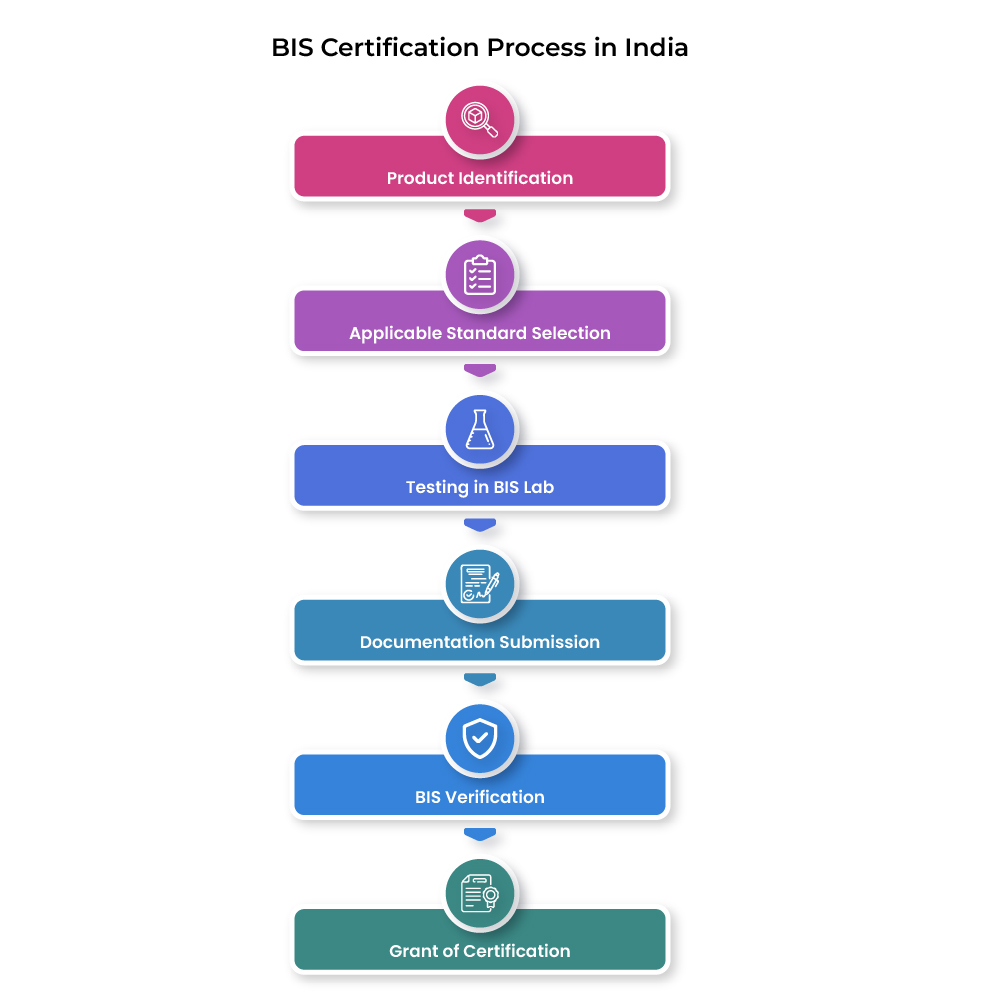
Figure 1
Documents Required for BIS Registration India
Manufacturers and importers must prepare several documents during the certification process.
Commonly required documents include:
- Business registration certificate
- Product specifications
- Test reports
- Factory details
- Authorization letters
- Application forms
Accurate documentation helps reduce delays and improves approval efficiency.
Benefits of BIS Certification India
Obtaining BIS certification offers multiple business and consumer benefits.
For Businesses
- Legal market access in India
- Improved product credibility
- Enhanced customer trust
- Competitive advantage
For Consumers
- Better product safety
- Assured quality standards
- Reduced risk of defective products
These advantages make BIS certification essential for regulated industries.
Challenges in Obtaining BIS Certificate
Manufacturers may face difficulties during the certification process due to procedural and technical requirements.
Common challenges include:
- Incorrect documentation
- Delays in product testing
- Misunderstanding compliance standards
- Incomplete applications
Professional guidance can simplify the process and ensure smooth approvals.
Conclusion
- BIS ensures product safety and quality in India
- The Bureau of Indian Standards regulates certification processes
- Different schemes apply to various product categories
- Proper testing and documentation are mandatory
- BIS certification enhances market credibility and compliance
In conclusion, BIS Certification is a vital regulatory requirement that ensures products comply with national quality and safety standards, helping businesses build trust and achieve seamless market access in India.
Recent Posts
How to Manufacture Class A & B Medical Devices in India: State FDA License Guide

A quick guide on the Class A & B Medical Device manufacturing license — covering State FDA rules, Form MD-3/MD-5, fees, and timelines for manufacturers. Every manufacturer entering India’s..
Importing Small Quantities of Cosmetics for R&D in India: NOC Requirements

A brief guide on Cosmetic import NOC India — covering when small quantity Cosmetic import for R&D testing bypasses full registration under Cosmetic rules 2020. Not every Cosmetic shipment into I..
The Cosmeceuticals Grey Zone: When a Cosmetic Claim Risks Becoming a Drug Claim

“Cosmeceutical” is a popular marketing word. It suggests something more powerful than an ordinary Cosmetic — a product that treats skin condition, not just improves appearance. The problem is th..
Need Help?
Submit your EnquiryOffice Locations
- Delhi
- Bangalore
- USA
- Singapore