
Table of Contents
Common Reasons for CDSCO Drug Import Application Rejections



CDSCO Drug Import applications are often rejected due to documentation errors, non-compliance, incorrect product classification, and delayed responses. Understanding these issues can improve approval of success and ensure smooth Regulatory Compliance.
The increasing demand for Imported Pharmaceutical products has made Regulatory Approval a critical requirement. However, CDSCO Application Rejection remains a common challenge for importers seeking market access in India.
The Central Drugs Standard Control Organization (CDSCO) regulates Drug Imports to ensure product safety, quality, and efficacy. Importers must comply with Regulatory requirements and submit complete documentation through the SUGAM portal.
Importance of Regulatory Compliance for Import License Approval
Obtaining Import License Approval requires strict adherence to CDSCO regulations. Any deviation from prescribed requirements may result in application delays, additional queries, or outright rejection.
Foreign manufacturers and Indian authorized agents must ensure that all submitted information is accurate, updated, and aligned with CDSCO guidelines.
Incomplete Documentation: A Leading Cause of CDSCO Application Rejection
Incomplete documentation is one of the most common reasons for rejection.
Missing certificates, , incomplete technical dossiers, or absent declarations can prevent CDSCO from evaluating the application effectively.
Commonly required documents include:
- Free Sale Certificate (FSC)
- Manufacturing License
- Power of Attorney
- GMP Certificate
- Product Specifications
- Label and Packaging Details
- Quality Certifications
Failure to provide any mandatory document may delay or reject the application.
Incorrect Product Classification and Regulatory Compliance Issues
Product classification plays a crucial role in the approval process.
Incorrect categorization of Drugs may lead to regulatory inconsistencies and additional scrutiny. CDSCO evaluates products based on specific regulatory pathways and submission requirements.
Importers should carefully determine whether the product falls under regulated Drug categories and submit the appropriate application forms.
Errors in SUGAM Portal Submission Affect Import License Approval
CDSCO applications are submitted through the SUGAM online portal.
Data entry mistakes, incorrect uploads, wrong file formats, or missing attachments can trigger application rejection / query. Even minor discrepancies between uploaded documents and application details may raise regulatory concerns.
Applicants should conduct a thorough review before final submission.
Table 1: Common CDSCO Drug Import Application Errors
| Error Type | Impact on Application |
| Incomplete g ovt fees | Immediate rejection or query |
| Wrong Product Classification | Delayed review process |
| Incorrect Portal Entries | Application deficiency notice |
| Missing GMP/FSC Certificates | Regulatory non-compliance |
| Unanswered CDSCO Queries | Application closure |
| Labeling Discrepancies | Additional review requirements |
| Incomplete Documentation | Query |
Failure to Respond to CDSCO Queries
CDSCO frequently raises clarification requests during application review.
Failure to provide timely responses can significantly affect approval timelines. Recent regulatory practices indicate that unanswered queries may lead to automatic application closure after the specified response period (CDSCO will share 3 reminders).
Applicants should establish an internal system for monitoring regulatory communications and responding promptly.
Non-Compliance with Labeling and Product Information Requirements
Labeling compliance is another critical factor.
Inconsistencies in product labels, packaging information, manufacturing details, or product specifications can result in regulatory objections. CDSCO requires Imported Drugs to comply with applicable labeling provisions under Indian regulations.
Proper label review before submission can help prevent avoidable deficiencies.
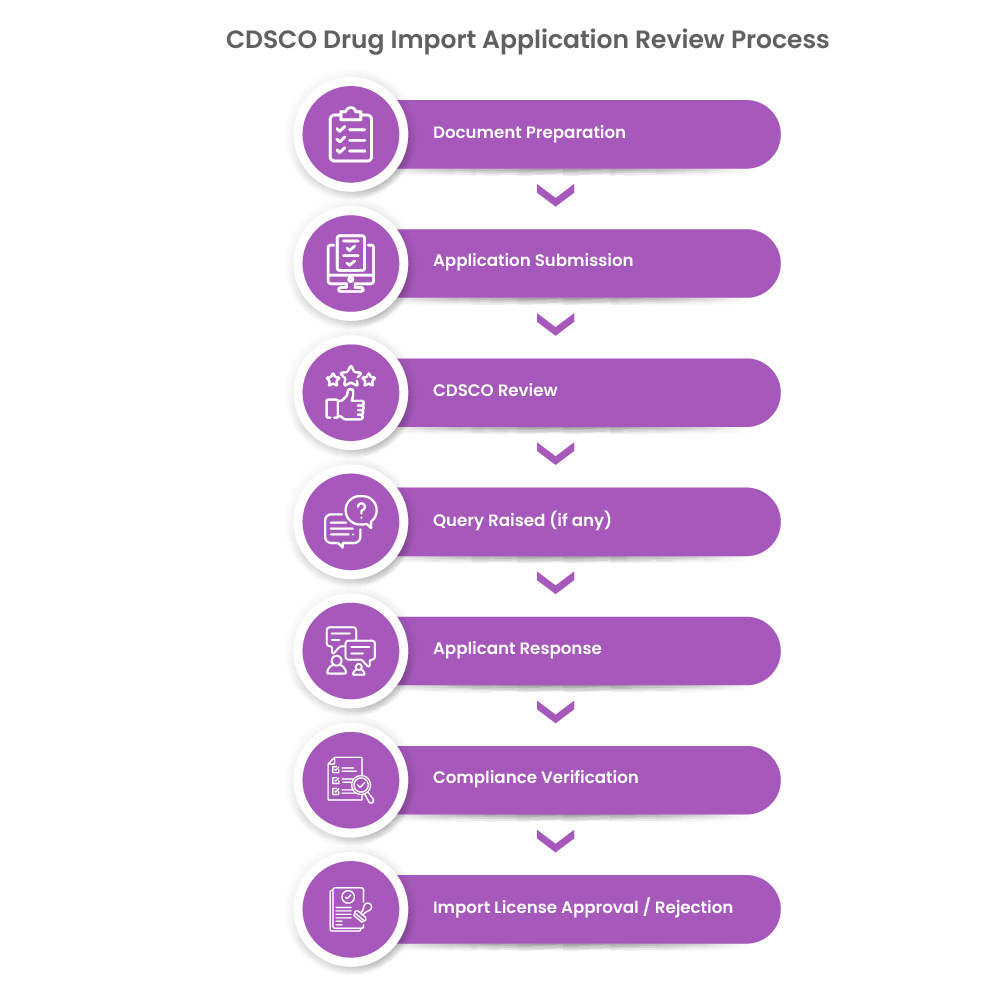
Figure 1
How to Avoid CDSCO Application Rejection
Organizations can improve approval of success rates by adopting a structured compliance approach.
Recommended practices include:
- Verify product classification before submission.
- Prepare complete and updated documentation.
- Ensure consistency across all application documents.
- Review SUGAM portal entries carefully.
- Monitor CDSCO communications regularly.
- Respond to regulatory queries within specified timelines.
- Conduct internal compliance audits before filing.
These measures can significantly improve the chances of successful Import License Approval while maintaining Regulatory Compliance.
Conclusion
Understanding the common causes of CDSCO Application Rejection helps Importers prepare stronger submissions and avoid costly delays. Accurate documentation, proper product classification, timely query responses, and continuous regulatory compliance are essential for successful approval and uninterrupted access to the Indian Pharmaceutical market.
Summary Points
- Incomplete documentation is a major cause of query .
- Incorrect product classification can delay approvals.
- SUGAM portal submission errors often trigger deficiencies.
- Failure to respond to CDSCO queries may result in application closure.
- Labeling non-compliance can lead to regulatory objections.
- Strong documentation and regulatory compliance improve approval success.
- Proactive preparation supports faster Import License Approval.

Saurangi is a food regulatory expert with 8 years of experience. She shares her knowledge and insights on regulatory updates, food trends, best practices, and news. Follow her for expert insights and practical advice on all things for food regulatory
Saurangi Shah
CliniExperts Services Pvt. Ltd.
Recent Posts
How to Manufacture Class A & B Medical Devices in India: State FDA License Guide
A quick guide on the Class A & B Medical Device manufacturing license — covering State FDA rules, Form MD-3/MD-5, fees, and timelines for manufacturers. Every manufacturer entering India’s..
Importing Small Quantities of Cosmetics for R&D in India: NOC Requirements

A brief guide on Cosmetic import NOC India — covering when small quantity Cosmetic import for R&D testing bypasses full registration under Cosmetic rules 2020. Not every Cosmetic shipment into I..
The Cosmeceuticals Grey Zone: When a Cosmetic Claim Risks Becoming a Drug Claim

“Cosmeceutical” is a popular marketing word. It suggests something more powerful than an ordinary Cosmetic — a product that treats skin condition, not just improves appearance. The problem is th..
Get In Touch With Our Team
-
Email: contact@cliniexperts.com
-
Timings: 9 am to 6 pm (Monday to Friday)
-
Location: India: Delhi, Bangalore Global: USA, Singapore