
Table of Contents
ISO 13485 for Indian Medical Device Manufacturers: What It Means for CDSCO Compliance


ISO 13485 is the internationally recognised standard for Quality Management Systems (QMS) in the Medical Device industry. For Indian manufacturers, it has become not just a global best-practice credential but an increasingly important element of CDSCO compliance under India’s Medical Devices Rules, 2017 (MDR 2017).
Despite this, many manufacturers — particularly smaller companies and those new to Medical Device manufacturing — are uncertain about the relationship between ISO 13485 and CDSCO requirements, whether ISO 13485 is mandatory, and how to approach certification effectively. This article addresses all of these questions comprehensively.
What Is ISO 13485?
ISO 13485:2016 is an international standard published by the International Organisation for Standardisation (ISO). It specifies requirements for a quality management system where an organisation needs to demonstrate its ability to provide medical devices and related services that consistently meet customer and applicable regulatory requirements.
Key areas covered by ISO 13485 include:
- Management responsibility and quality policy
- Resource management — personnel, infrastructure, work environment
- Product realisation — design and development, purchasing, production, and service provision
- Measurement, analysis, and improvement — including corrective and preventive action (CAPA)
- Risk management throughout the product lifecycle
- Post-market surveillance and feedback systems
ISO 13485 is not simply an ISO 9001 equivalent for Medical Devices. It contains specific requirements related to sterile device manufacturing, implantable device traceability, clinical evaluation, regulatory reporting, and post-market surveillance that go significantly beyond general quality management standards.
ISO 13485 and MDR 2017: What Does Indian Law Actually Require?
MDR 2017 set out the Essential Principles of Safety and Performance that all Medical Devices sold in India must comply with. MDR 2017 does not explicitly mandate a third-party ISO 13485 certification as a universal requirement for all manufacturers. However, ISO 13485 is highly relevant to CDSCO compliance in several important ways:
- CDSCO site inspections for Class C and D manufacturing licenses assess the manufacturer’s QMS against standards substantially equivalent to ISO 13485
- Import license applications for Class C and D Devices expect quality system evidence consistent with ISO 13485 principles
- ISO 13485 certification from an accredited third-party certification body is accepted by CDSCO as evidence of a compliant QMS
- For export from India to regulated markets (EU, US, Canada, Australia), ISO 13485 is effectively mandatory — most importers and regulators in these markets require it
Why Indian Manufacturers Should Pursue ISO 13485 Certification
Beyond regulatory compliance, ISO 13485 certification provides Indian manufacturers with significant strategic and commercial advantages:
| Benefit | Detail |
| CDSCO inspection readiness | A certified QMS systematically prepares manufacturers for the documentation and process requirements CDSCO inspectors look for |
| Export eligibility | Required by EU (MDR 2017 Article 10), US FDA quality system requirements, and most global distributors |
| OEM and partnership access | Global Medtech companies require ISO 13485 from their Indian supply chain and manufacturing partners |
| Reduced product recall risk | Structured CAPA, risk management, and process controls reduce the likelihood of quality failures |
| Investor and buyer confidence | ISO 13485 certification signals organisational maturity and regulatory seriousness to investors and M&A counterparts |
| Make in India alignment | Government procurement and DPIIT-linked schemes increasingly favour ISO-certified manufacturers |
Table 1
Key Elements CDSCO Inspectors Look for That Align with ISO 13485
When CDSCO conducts a manufacturing site inspection for Class C/D licenses, the following elements — all aligned with ISO 13485 — receive particular scrutiny:
- Design and Development Controls: documented design history file, design verification and validation records, and design change control procedures
- Supplier and Purchasing Controls: approved supplier list, incoming inspection procedures, and supplier qualification records
- Production and Process Controls: validated manufacturing processes, in-process inspection records, and batch manufacturing records
- Sterilisation Validation: for sterile devices, full sterilisation validation data and periodic revalidation records
- Corrective and Preventive Action (CAPA): a functioning CAPA system with documented investigations and effectiveness checks
- Post-Market Surveillance: procedures for collecting and reviewing post-market data including complaint handling and adverse event reporting
- Management Review: evidence that senior management is actively engaged in QMS oversight
Common Gaps Found in Indian Manufacturers’ QMS During CDSCO Inspections
- Risk management files that are incomplete or not updated after design changes
- Supplier qualification records missing for critical component suppliers
- CAPA system that records actions but does not verify effectiveness
- Post-market surveillance procedures that exist on paper but are not actively implemented
- Design history files that are incomplete — particularly for older products developed before MDR 2017 came into force
- Inadequate training records for production and quality personnel
Steps to Achieve ISO 13485 Certification
- Gap analysis: Assess current QMS against ISO 13485:2016 requirements to identify gaps
- QMS development: Document and implement the required policies, procedures, and records
- Internal training: Train all relevant personnel on the new QMS requirements and their roles
- Internal audit: Conduct a full internal audit of the QMS before external certification
- Management review: Complete a formal management review meeting
- Stage 1 audit (documentation review): Certification body reviews your documentation
- Stage 2 audit (on-site assessment): Certification body conducts on-site assessment of your QMS implementation
- Certification issued: Upon successful completion, ISO 13485 certificate is issued (valid for 3 years with annual surveillance audits)
Typical timeline from gap analysis to certification: 6–12 months for a well-resourced manufacturer committed to the process. Companies with an existing ISO 9001 QMS can often achieve this in 4–8 months.
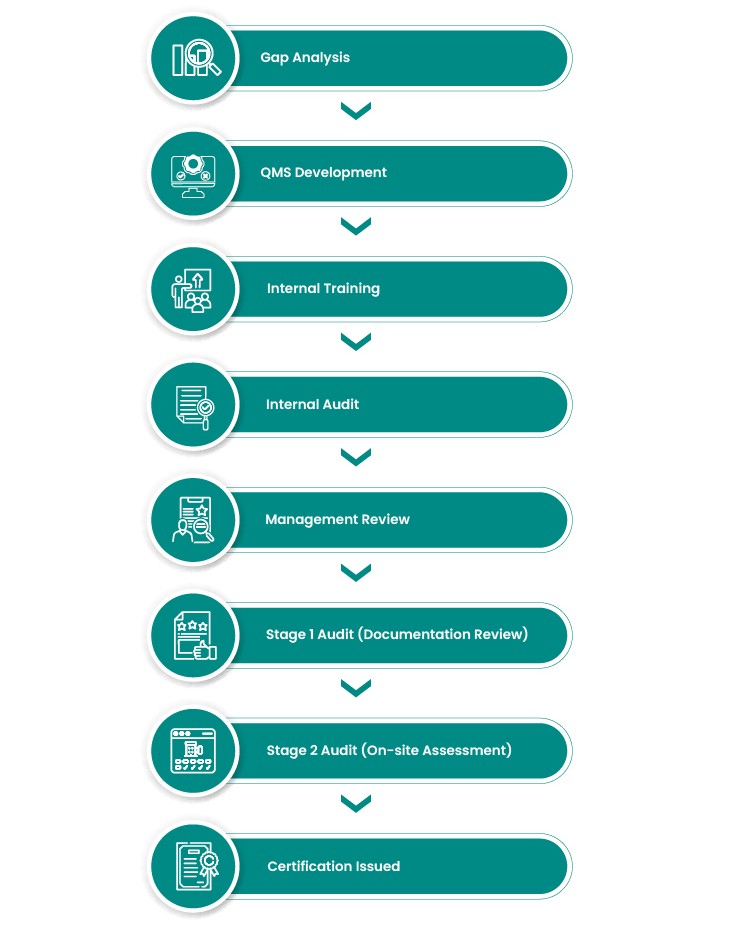
Figure1
ISO 13485 and the Future of Indian Medtech Regulation
CDSCO’s regulatory trajectory is clearly moving toward greater alignment with international standards. The increasing emphasis on technical documentation, post-market surveillance, and quality system compliance in recent CDSCO guidance mirrors the requirements in ISO 13485. Companies that invest in ISO 13485 certification today are not just meeting current expectations — they are building the regulatory infrastructure for India’s Medtech future.
Conclusion
ISO 13485 is the quality backbone of the Indian Medical Device industry. For manufacturers, it is the most credible and practical tool for demonstrating compliance with CDSCO’s QMS expectations, accessing global markets, and building the organisational capability required for sustainable growth in India’s evolving Medtech sector.
About CliniExperts
CliniExperts Services Pvt. Ltd. is a leading healthcare Regulatory consulting firm headquartered in Bengaluru and New Delhi, India, serving 300+ global healthcare companies across 40+ countries. We provide end-to-end regulatory, clinical, and medical affairs services for Medical Device, Pharmaceutical, and healthcare companies entering and operating in India.
www.cliniexperts.com | contact@cliniexperts.com

Saurangi is a food regulatory expert with 8 years of experience. She shares her knowledge and insights on regulatory updates, food trends, best practices, and news. Follow her for expert insights and practical advice on all things for food regulatory
Saurangi Shah
CliniExperts Services Pvt. Ltd.
Recent Posts
Importing Small Quantities of Cosmetics for R&D in India: NOC Requirements

A brief guide on Cosmetic import NOC India — covering when small quantity Cosmetic import for R&D testing bypasses full registration under Cosmetic rules 2020. Not every Cosmetic shipment into I..
The Cosmeceuticals Grey Zone: When a Cosmetic Claim Risks Becoming a Drug Claim

“Cosmeceutical” is a popular marketing word. It suggests something more powerful than an ordinary Cosmetic — a product that treats skin condition, not just improves appearance. The problem is th..
Ingredient Safety Dossiers: Building a Defensible Package for Novel Actives

Companies developing Cosmetics with new or unusual active ingredients face a higher regulatory bar in India than those using well-established formulations. Understanding what “new” means under the..
Need Help?
Submit your EnquiryOffice Locations
- Delhi
- Bangalore
- USA
- Singapore