
Table of Contents
Import License – Form 10 for Biologicals: Process, Documents and Timeline



Understand the CDSCO requirements for Importing Biological products into India, including Form 10 licensing, Form 41 registration, New Drug permission under CT-19/CT-20, essential documents, fees and timelines.
Introduction
Importing Biological products into India involves more than arranging shipments from overseas manufacturers. Companies must first complete the required regulatory formalities and obtain permission from the Central Drugs Standard Control Organisation (CDSCO).
Whether the product is a vaccine, blood product, recombinant DNA product or stem cell, understanding the Biological Import License India process is essential to avoid regulatory complications and import delays.
An important requirement that importers should not overlook is new drug permission. Under the New Drugs and Clinical Trials Rules, 2019, specified biological products are always deemed to be new drugs. Therefore, obtaining the applicable permission in Form CT-19 or CT-20 is an additional regulatory requirement before proceeding with the import licence application.
Understanding Form 10 Import License for Biologicals
Under the Drugs and Cosmetics Rules, 1945, specified Biological Products require an import licence before commercial import into India.
The process involves three important regulatory stages: registration of the foreign manufacturing site and product, obtaining new drug permission, and securing the final import licence.
The relevant forms serve different purposes:
- Form 40: Application for Registration Certificate.
- Form 41: Registration Certificate issued by CDSCO.
- Form CT-18: Application for permission to import a new drug for sale or distribution.
- Form CT-19: Permission to import a new drug in the form of an active pharmaceutical ingredient (API).
- Form CT-20: Permission to import a new drug in the form of a pharmaceutical formulation.
- Form 8: Application for an import licence.
- Form 9: Manufacturer’s or authorised agent’s undertaking.
- Form 10: Final import licence.
Obtaining Form 41 does not automatically permit commercial imports. The importer must complete the separate Form 10 licensing process.
Who Can Apply for a Biological Import License in India?
Before starting the application, companies should check their eligibility. Applicants must hold the appropriate licence under the Drugs and Cosmetics Rules.
Eligible applicants generally include:
- Wholesalers holding licences in Form 20B, 21B or 21C, as applicable.
- Manufacturers holding manufacturing licences in Form 25 or 28, as applicable.
The applicant’s business details and licence information should remain consistent across all submitted documents.
Form 10 Import License Biologicals: Application Process
Once the required Registration Certificate is available, the importer can proceed with the application.
- SUGAM Registration: Create an account on the CDSCO SUGAM portal.
- Complete Form 8: Enter the importer, manufacturer and product details.
- Upload Documents: Attach the required licences, undertaking and product labels and applicable CT-19/CT-20 permission.
- Pay Government Fees: Submit the prescribed application fee.
- Application Submission: Upload the signed application for CDSCO review.
- Regulatory Review: Respond to any additional queries raised by the authority.
- Licence Grant: Once requirements are fulfilled, CDSCO grants the licence in Form 10.
Documents Required for CDSCO Biological Import
Incomplete documentation is a common reason for regulatory queries. Preparing the required documents beforehand can make the application process smoother.
| Document | Purpose |
| Registration Certificate (Form 41) | Confirms site and product registration |
| New Drug Permission (CT-19/CT-20) | Establishes CDSCO permission to import the applicable biological product as a new drug |
| Wholesale Licence | Establishes importer eligibility |
| Manufacturing Licence | Required for eligible manufacturer applicants |
| Form 9 | Manufacturer’s or authorised agent’s undertaking |
| Product Labels | Demonstrates Indian labelling compliance |
| Covering Letter | Provides application details |
Table 1
Vaccine Import License: Important Considerations
Vaccine imports need particular attention because these products have specific storage, handling and quality requirements.
Importers should check that product labels comply with Rule 96 of the Drugs and Cosmetics Rules, 1945. They should also ensure that:
- Conditions mentioned in the Registration Certificate are fulfilled.
- Importer details match the relevant business licence.
- Form 9 is properly signed.
- Applicable new drug permission is available, wherever required.
- Appropriate cold-chain and batch quality arrangements are in place.
Addressing these requirements before shipment can help prevent avoidable import-related complications.
Form 10 Approval Timeline, Fees and Validity
Importers should consider the applicable fees and processing time while planning their regulatory submissions.
| Particular | Details |
| New drug application | Form CT-18 |
| New drug permission | Form CT-19 or CT-20, as applicable |
| Application form | Form 8 |
| Final licence | Form 10 |
| Government fee | ₹10,000 for one product |
| Additional product fee | ₹1,000 per product |
| Indicative processing time | 45 days |
| Licence validity | Three years or until Form 41 expires, whichever is earlier |
Table 2
The 45-day period should be treated as indicative rather than guaranteed. Incomplete applications and additional regulatory queries may extend the process.
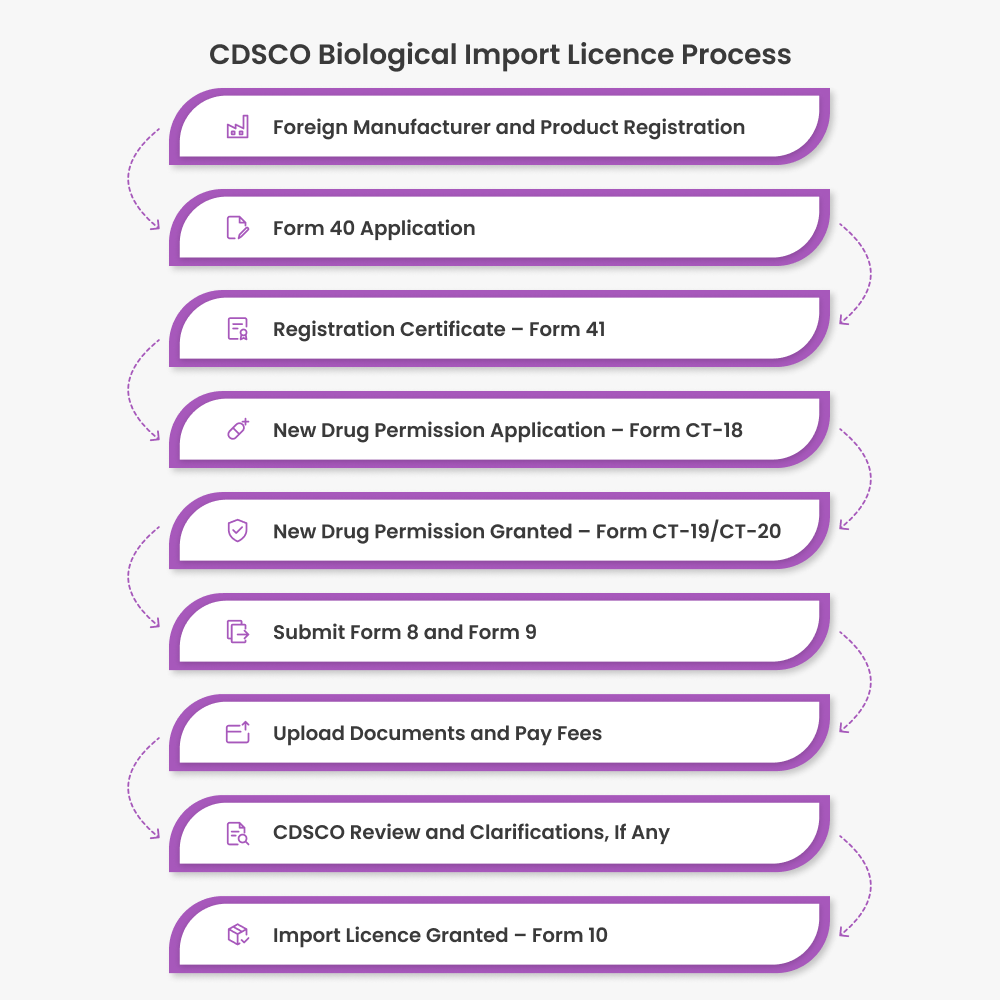
Figure 1
Conclusion
Obtaining an import licence becomes easier when companies understand the regulatory sequence and prepare their documents in advance.
- Form 40 is used for registration, and Form 41 is the Registration Certificate.
- Form CT-18 is used to apply for new drug permission, while CT-19 and CT-20 are the respective permission forms for APIs and pharmaceutical formulations.
- Form 8 is the import licence application.
- Form 9 is an important supporting undertaking.
- Form 10 is the final import licence.
- Vaccine imports require additional attention to storage and quality requirements.
- Fees and timelines should be verified before submission.
Understanding the Biological Import License India requirements helps manufacturers and importers plan their submissions, minimise documentation-related delays and bring biological products into the Indian market through the appropriate CDSCO pathway.
Recent Posts
Schedule M Revisions: How Will They Impact Pharmaceutical Manufacturers?

What a Revised Schedule M raises GMP standards in India, what has changed for manufacturers, and how large firms and MSMEs can prepare for Compliance and CDSCO inspections. Revised Schedule M is the b..
CDSCO vs US FDA vs EMA: Why the Same Drug Faces Different Approval Requirements
A practical comparison of CDSCO vs FDA vs EMA, explaining how each regulator’s Drug approval process differs and why one Drug needs separate approvals in India, the US and Europe. A Drug approve..
Get In Touch With Our Team
-
Email: contact@cliniexperts.com
-
Timings: 9 am to 6 pm (Monday to Friday)
-
Location: India: Delhi, Bangalore Global: USA, Singapore