
Table of Contents
Post Approval Changes for Biologicals in India: Major and Minor Changes Explained



Learn how CDSCO classifies post-approval changes in biological products in India, including major and minor modifications, Level I to IV changes, manufacturing site changes and documentation requirements.
Introduction
Getting a Biological product approved is a major milestone for any manufacturer. However, the work does not stop once the product enters the market. Manufacturing processes evolve, facilities undergo upgrades, suppliers change, and companies may need to modify product specifications.
But can manufacturers make these changes whenever required? Not without considering their regulatory impact. Post Approval Changes for Biologicals must be assessed carefully to ensure that the product continues to meet its approved quality, safety and efficacy requirements.
Understanding CDSCO Post-Approval Changes
The Central Drugs Standard Control Organisation (CDSCO) has established guidelines to help manufacturers manage changes to already approved biological products. The updated guidance, Version 1.2, adopted in May 2024, follows a science-based and risk-based approach.
The idea is simple: not every modification carries the same level of risk. Changing a manufacturing process may have a different impact from replacing a non-critical packaging component.
Based on their potential impact, quality-related changes are classified into four reporting categories: Level I, II, III and IV.
| Category | Nature of change | Regulatory requirement |
| Level I | Major quality changes | Supplement; prior CDSCO approval |
| Level II | Moderate quality changes | Notifiable Change; prior CDSCO approval |
| Level III | Minor quality changes | Annual notification |
| Level IV | Changes with no expected adverse quality impact | Maintain records under GMP |
Table1
Level I – Major Quality Changes
These changes have a substantial potential to affect product quality, safety or efficacy. Examples may include significant modifications to the manufacturing process or the introduction of a manufacturing facility at a new geographical location.
Manufacturers must submit a Supplement with the relevant supporting data and obtain CDSCO approval before commercial implementation.
Level II – Moderate Quality Changes
These changes carry a moderate potential impact on product quality. For example, adding a manufacturing facility within an existing approved site may fall under this category when the prescribed conditions are met.
The manufacturer must submit a Notifiable Change along with supporting documents. Prior CDSCO approval is required before commercial implementation.
Level III – Minor Quality Changes
These changes have minimal potential to affect product quality. Certain changes in manufacturing arrangements or equipment may qualify, provided the conditions specified in the guidance are fulfilled.
They can generally be implemented without prior CDSCO review. However, an annual notification must be submitted during the first quarter of the following calendar year. Shelf-life extensions require prior approval.
Level IV – Record of Changes
These modifications are not expected to adversely affect product quality, safety or efficacy. Examples include replacing non-product-contact equipment with identical equipment or correcting typographical errors in product labelling without changing its content.
Prior CDSCO review is not required, but manufacturers must maintain appropriate records and follow GMP requirements.
Manufacturing Site Change Approval
A change in manufacturing site deserves particular attention, especially for biological products. Moving production to another facility can affect process controls, contamination risks and product consistency.
Under CDSCO guidance, adding or replacing a drug substance manufacturing facility at a new geographical location is generally classified as a Level I Supplement. However, adding a facility within an existing approved site may qualify as a Level II Notifiable Change if the specified conditions are met.
For applicable changes involving a new geographical site, the manufacturer must submit an application through SUGAM in Form CT-21 or CT-18, along with the prescribed fees and supporting documents. CDSCO issues a No Objection Certificate for the applicable amendment or endorsement of the existing Form 28-D licence.
Documentation Required for CDSCO Post-Approval Changes
Documentation plays an important role in demonstrating that a proposed modification will not compromise the biological product. The requirements depend on the nature and reporting category of the change.
For major and moderate quality changes, the supporting documents may include:
- A covering letter describing the proposed change.
- A comparison of previously approved and revised information.
- Scientific justification and risk assessment.
- Updated manufacturing process descriptions and flowcharts.
- Process validation and analytical data, wherever applicable.
- Comparative batch analysis and product characterisation.
- Stability data and relevant commitments.
For biological products, comparability studies are particularly important. They help establish whether the product manufactured before and after a change remains comparable in terms of its quality and relevant safety and efficacy characteristics.
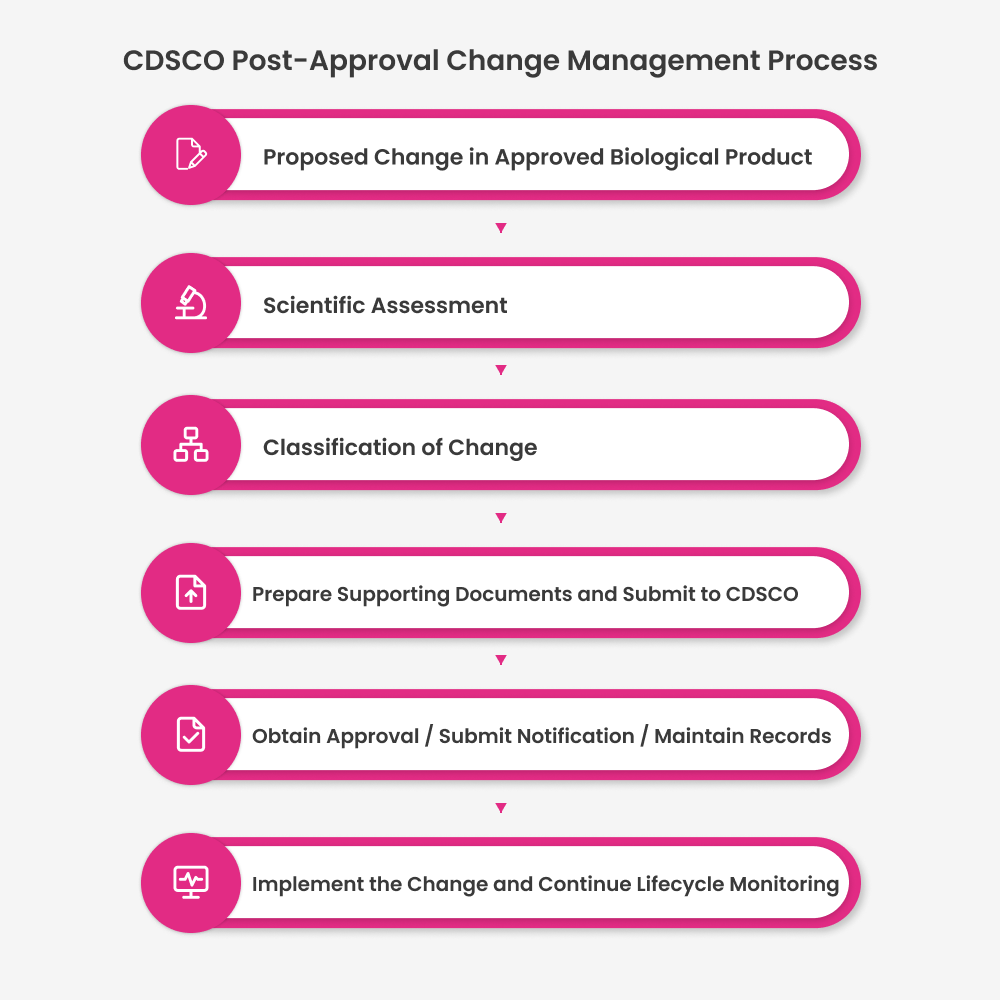
Figure 1
Conclusion
Post-approval compliance is not just about submitting documents whenever a modification is made. It is about understanding how every change could affect the product and choosing the appropriate regulatory route.
Here are the main points to remember:
- Level I changes require prior CDSCO approval.
- Level II changes also require prior approval through a Notifiable Change submission.
- Level III changes generally follow an annual notification process.
- Level IV changes require proper documentation and GMP compliance.
- Manufacturing site modifications need careful regulatory assessment.
- Comparability and validation data help demonstrate continued product consistency.
Managing Post Approval Changes for Biologicals correctly helps manufacturers maintain regulatory compliance, avoid unnecessary delays and ensure that approved products continue to meet the required quality, safety and efficacy standards.
Recent Posts
Import License – Form 10 for Biologicals: Process, Documents and Timeline
Understand the CDSCO requirements for Importing Biological products into India, including Form 10 licensing, Form 41 registration, New Drug permission under CT-19/CT-20, essential documents, fees and ..
Schedule M Revisions: How Will They Impact Pharmaceutical Manufacturers?

What a Revised Schedule M raises GMP standards in India, what has changed for manufacturers, and how large firms and MSMEs can prepare for Compliance and CDSCO inspections. Revised Schedule M is the b..
Get In Touch With Our Team
-
Email: contact@cliniexperts.com
-
Timings: 9 am to 6 pm (Monday to Friday)
-
Location: India: Delhi, Bangalore Global: USA, Singapore