
Table of Contents
FSSAI Compliance Checklist for Food Importers in India


Food import compliance India requires understanding FSSAI regulations, standards and documentation for importing food products legally and safely into India. Ensuring full compliance helps avoid legal penalties, customs delays, and ensures the safety and quality of imported food.
What is FSSAI Import Compliance & Why It Matters
FSSAI import requirements ensure food safety standards India for all imported food articles by regulating quality, labeling, documentation and inspections.
Compliance protects public health and prevents unsafe or sub-standard food entering the Indian market.
Import Licensing Essentials under FSSAI
Importers must have:
- Central FSSAI import license from FSSAI
- Import Export Code (IEC) issued by DGFT
- Valid business registration and legal entity status in India.
Licenses are valid for 1–5 years, and renewal before expiration is essential to maintain compliance.
Food Import Clearance System (FICS) – Step-by-Step
FSSAI’s Food Import Clearance System (FICS) is the online portal for applying for import clearance and NOC.
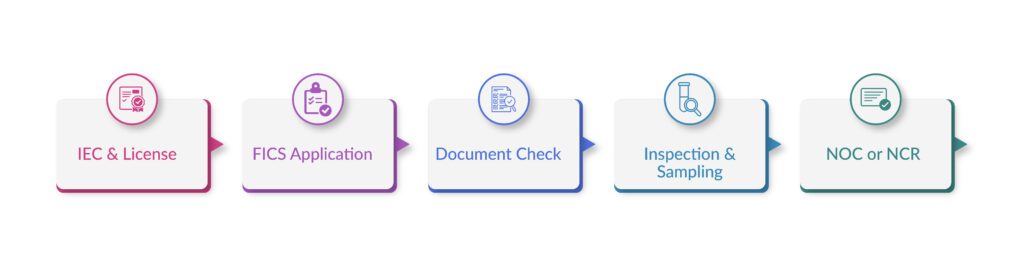
Documents mandatory for FSSAI import clearance under food safety standards India.
| Document | Purpose |
| Import Export Code (IEC) | Required by customs & FSSAI |
| FSSAI Import License | Mandatory for import clearance |
| Country of Origin Certificate | Confirms food source |
| Certificate of Analysis | Safety parameter details |
| Other Permits (if applicable) | E.g., agriculture/animal origin certificates |
Labeling & Packaging Requirements
Imported food must comply with FSSAI Packaging & Labeling Regulations 2011, including:
- Ingredient list
- Net quantity, weight and batch code
- Best before/use by date
- Name & address of importer
- FSSAI license number & veg/non-veg logo.
Label Compliance Checklist:
- Country of origin
- Storage instructions
- Nutritional details (if applicable)
- Legible language and formatting.
Inspection, Sampling & Testing Procedure
FSSAI conducts:
- Document scrutiny
- Visual inspection
- Sampling & laboratory analysis
If compliant ⇒ No Objection Certificate (NOC) issued.
If not ⇒ Non-Conformance Report (NCR) issued.
Rights After Non-Conformance
Importers can:
- Request retesting
- File a first review appeal using Form-6
- File a second appeal with the CEO of FSSAI
- Appeals require payment of specified fees and grounds for review.
Special & Exempted Imports
Certain consignments may not need FSSAI clearance if they are:
- For re-export
- For R&D or exhibitions
- Imported by DIPLOMATIC missions
- For sports/fair use (with declaration)
- Exemptions are governed under FSS (Import) Regulations, 2017.
Registration of Foreign Food Facilities (Reform)
For certain high-risk categories (e.g., milk, meat, infant food), foreign facilities must be registered on Reform before exporting to India. Importers must ensure suppliers are registered to avoid delays at customs.
Post-Clearance Compliance
After clearance, importers must:
- Maintain records of imports
- Store products as per FSSAI conditions
- File annual returns to FSSAI
- Documentation and traceability uphold ongoing food safety standards India.
Common Compliance Challenges & Tips
Challenges:
- Incomplete documentation
- Incorrect labeling
- Delayed supplier registration
Tips:
- Pre-verify documents before filing in FICS
- Track deadlines for renewals
- Liaise proactively with customs & FSSAI.
Conclusion: Ensuring FSSAI Import Success
Meeting food import compliance India requirements means aligning with FSSAI import requirements, clear documentation, correct labeling, and proactive submission via FICS.
Key Takeaways:
- Always validate IEC & FSSAI licenses
- Follow labeling & packaging rules
- Use FICS for clearance tracking
- Be ready for inspections and testing
Summary
- Valid IEC & FSSAI import licenses are mandatory.
- Apply through FICS for clearance and NOC.
- Ensure correct labeling & packaging per FSSAI.
- Keep the complete document checklist ready.
- Respond to inspections, samples, & tests promptly.
- Use appeal rights if necessary.
- Maintain post-clearance compliance and annual returns.
Recent Posts
How to Manufacture Class A & B Medical Devices in India: State FDA License Guide
A quick guide on the Class A & B Medical Device manufacturing license — covering State FDA rules, Form MD-3/MD-5, fees, and timelines for manufacturers. Every manufacturer entering India’s..
Importing Small Quantities of Cosmetics for R&D in India: NOC Requirements

A brief guide on Cosmetic import NOC India — covering when small quantity Cosmetic import for R&D testing bypasses full registration under Cosmetic rules 2020. Not every Cosmetic shipment into I..
The Cosmeceuticals Grey Zone: When a Cosmetic Claim Risks Becoming a Drug Claim

“Cosmeceutical” is a popular marketing word. It suggests something more powerful than an ordinary Cosmetic — a product that treats skin condition, not just improves appearance. The problem is th..
Get In Touch With Our Team
-
Email: contact@cliniexperts.com
-
Timings: 9 am to 6 pm (Monday to Friday)
-
Location: India: Delhi, Bangalore Global: USA, Singapore