
Table of Contents
Regulatory Pathway for Biologicals in India: Approval Process & Key Requirements



The Regulatory Pathway for Biologicals in India is governed by strict guidelines to ensure the safety, efficacy, and quality of biological products. Manufacturers must follow regulatory frameworks established by CDSCO and the Ministry of Health before market entry.
Biological products such as vaccines, monoclonal antibodies, and recombinant therapeutics require extensive evaluation. Understanding the Regulatory Pathway for Biologicals in India helps manufacturers navigate approval requirements efficiently.
Understanding the Regulatory Pathway for Biologicals in India
The Regulatory Pathway for Biologicals in India involves multiple stages of evaluation including preclinical research, clinical trials, regulatory review, and manufacturing approval.
Biological products are regulated under the Drugs and Cosmetics Act, 1940 and New Drugs and Clinical Trials Rules (NDCTR), 2019.
These regulations ensure biological products meet international safety and quality standards before commercialization.
Types of Biological Products Regulated in India
Biologicals include a wide range of therapeutic products derived from living organisms.
Common categories include:
- Vaccines
- Recombinant proteins
- Monoclonal antibodies
- Gene therapy products
- Blood products
- Biosimilars
Each category may require different regulatory documentation and evaluation processes.
Key Regulatory Authorities for Biological Approvals
Several regulatory bodies oversee biological product approvals in India.
The main regulatory authorities include:
- Central Drugs Standard Control Organization (CDSCO) – Primary regulatory authority
- Drug Controller General of India (DCGI) – Approves clinical trials and marketing authorization
- Department of Biotechnology (DBT) – Provides scientific oversight
- Review Committee on Genetic Manipulation (RCGM) – Evaluates genetically engineered products
These authorities work together to regulate biological drug development and approval.
Key Regulatory Authorities for Biologicals in India
| Authority | Role | Responsibility |
| CDSCO | National Regulatory Authority | Approves biological products and licensing |
| DCGI | Drug Regulatory Head | Grants marketing authorization |
| DBT | Scientific Oversight | Regulates biotechnology research |
| RCGM | Genetic Engineering Oversight | Reviews recombinant biological products |
Table 1: the main regulatory authorities responsible for evaluating, approving, and monitoring biological products in India.
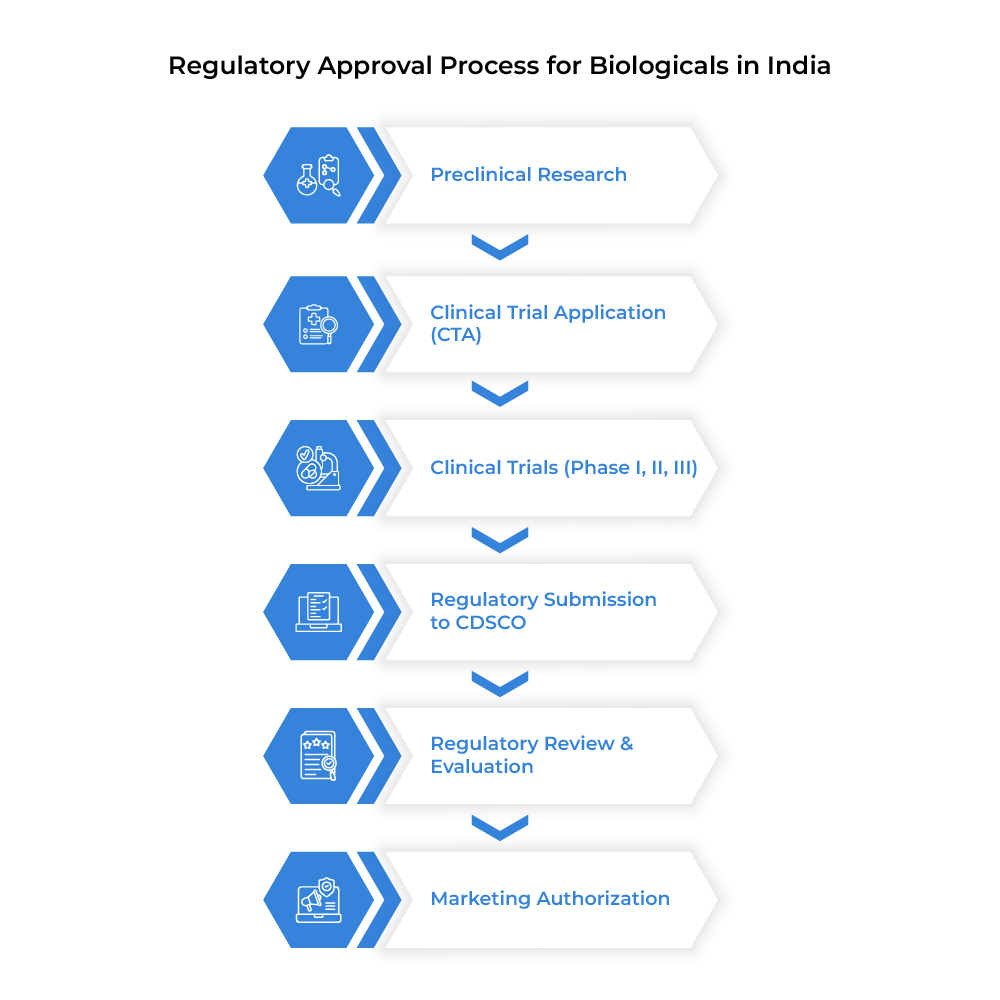
Approval Process for Biological Products
Manufacturers must follow a structured regulatory process before biological products can enter the market.
Documentation Requirements for Biological Product Approval
Manufacturers must submit comprehensive documentation during regulatory submissions.
Important regulatory documents include:
- Chemistry, Manufacturing and Controls (CMC) data
- Clinical trial protocols and reports
- Preclinical study data
- Risk management plans
- Stability study reports
- Manufacturing process details
Complete documentation ensures regulatory transparency and improves approval timelines.
Clinical Trial Requirements for Biologicals
Clinical trials are a critical component of the Regulatory Pathway for Biologicals in India.
Biological products must undergo phased clinical testing to evaluate safety and efficacy.
Clinical trial phases include:
- Phase I: Safety evaluation in small groups
- Phase II: Dose determination and efficacy assessment
- Phase III: Large-scale safety and effectiveness evaluation
All trials must receive approval from DCGI and Ethics Committees before initiation.
Challenges in Biological Product Approval
Manufacturers may face regulatory challenges when developing biological products.
Common challenges include:
- Complex manufacturing processes
- Stringent regulatory documentation requirements
- High clinical trial costs
- Long approval timelines
- Changing regulatory policies
Early regulatory planning helps companies overcome these challenges.
Conclusion
Developing and commercializing biological products requires a clear understanding of regulatory frameworks. The Regulatory Pathway for Biologicals in India ensures that biological therapies meet strict safety, quality, and efficacy standards.
By complying with regulatory guidelines, submitting complete documentation, and conducting well-designed clinical trials, manufacturers can successfully navigate the Regulatory Pathway for Biologicals in India and bring innovative biological therapies to the market.
Summary
- Biological products in India are regulated under the Drugs and Cosmetics Act and NDCTR 2019.
- CDSCO and DCGI oversee regulatory approval for biological products.
- Biological products include vaccines, monoclonal antibodies, and recombinant proteins.
- The approval process involves preclinical research, clinical trials, and regulatory review.
- Documentation such as CMC data, clinical reports, and stability studies is required.
- Clinical trials must be approved by DCGI and ethics committees.
- Proper regulatory planning helps manufacturers achieve faster approvals.

Saurangi is a food regulatory expert with 8 years of experience. She shares her knowledge and insights on regulatory updates, food trends, best practices, and news. Follow her for expert insights and practical advice on all things for food regulatory
Saurangi Shah
CliniExperts Services Pvt. Ltd.
Recent Posts
How to Manufacture Class A & B Medical Devices in India: State FDA License Guide

A quick guide on the Class A & B Medical Device manufacturing license — covering State FDA rules, Form MD-3/MD-5, fees, and timelines for manufacturers. Every manufacturer entering India’s..
Importing Small Quantities of Cosmetics for R&D in India: NOC Requirements
A brief guide on Cosmetic import NOC India — covering when small quantity Cosmetic import for R&D testing bypasses full registration under Cosmetic rules 2020. Not every Cosmetic shipment into I..
The Cosmeceuticals Grey Zone: When a Cosmetic Claim Risks Becoming a Drug Claim

“Cosmeceutical” is a popular marketing word. It suggests something more powerful than an ordinary Cosmetic — a product that treats skin condition, not just improves appearance. The problem is th..
Get In Touch With Our Team
-
Email: contact@cliniexperts.com
-
Timings: 9 am to 6 pm (Monday to Friday)
-
Location: India: Delhi, Bangalore Global: USA, Singapore