
Table of Contents
AI in Pharma Industry: Boon or Bane


Artificial Intelligence is reshaping the Pharmaceutical industry by enhancing research efficiency, accelerating Drug development, and improving data-driven decision-making. However, its use also raises concerns related to privacy, bias, and regulatory compliance. While AI offers significant benefits across the drug lifecycle, its safe and ethical application depends on strong governance, transparency, and continuous monitoring within regulated healthcare and manufacturing environments.
AI in the Pharma Industry: Boon or Bane?
Introduction
Artificial Intelligence (AI) employs algorithms to learn from data and perform automated tasks without explicit programming of every step. It is increasingly being used across the Pharmaceutical industry, especially in drug discovery, development, and delivery processes.1 In recent years, there has been a rapid rise in the adoption of AI due to its ability to handle complex and large datasets efficiently. Pharmaceutical companies are now using AI to improve research efficiency and reduce long drug development timelines.
Traditionally, Drug development takes 10 to 15 years and involves steep costs, which has pushed the industry to adopt AI-based solutions. AI helps in identifying drug targets, predicting outcomes, and optimizing molecules before actual production.2 At the same time, global organizations recognize that while AI offers strong potential for improving healthcare, it also brings ethical and regulatory challenges. Therefore, proper guidelines and monitoring are necessary to ensure safe and effective use of AI in the Pharmaceutical sector.1
How AI is Used in the Pharma Industry
Artificial intelligence is used across the entire pharmaceutical lifecycle, from early research to delivery and marketing of medicines. It helps automate tasks and supports scientists in improving efficiency during different stages of development. The table below summarizes the key areas where AI is applied in the Pharmaceutical industry:
Table 1: Applications of AI in the Pharmaceutical Industry
| Stage of Pharma Lifecycle | Application of AI |
| Basic Scientific Research | AI supports hypothesis generation and evaluation. It also predicts protein structures to improve understanding of diseases at a molecular level. |
| Drug Discovery and Design | AI identifies Drug targets using biological datasets and disease markers. It also supports molecule design, Drug-target prediction, and compound screening. |
| Preclinical Development | AI predicts toxicity and drug behaviour before human trials. It enables in-silico testing and pharmacokinetic modelling to reduce laboratory experiments. |
| Clinical Trials | AI assists in trial design, patient selection, and outcome prediction. It also supports recruitment using electronic health records and detects adverse events in real time. |
| Manufacturing and Quality Control | AI is used for process design, monitoring, fault detection, optimisation, and predictive maintenance in production systems. |
| Supply Chain Management | AI helps forecast demand, monitor logistics, and improve distribution planning for medicines. |
| Post-Market Surveillance | AI supports pharmacovigilance by automating reporting and detecting adverse drug reactions using real-world data. |
| Marketing and Patient Support | AI is used for pricing strategies, demand forecasting, targeted marketing, and sales prediction using analytics. |
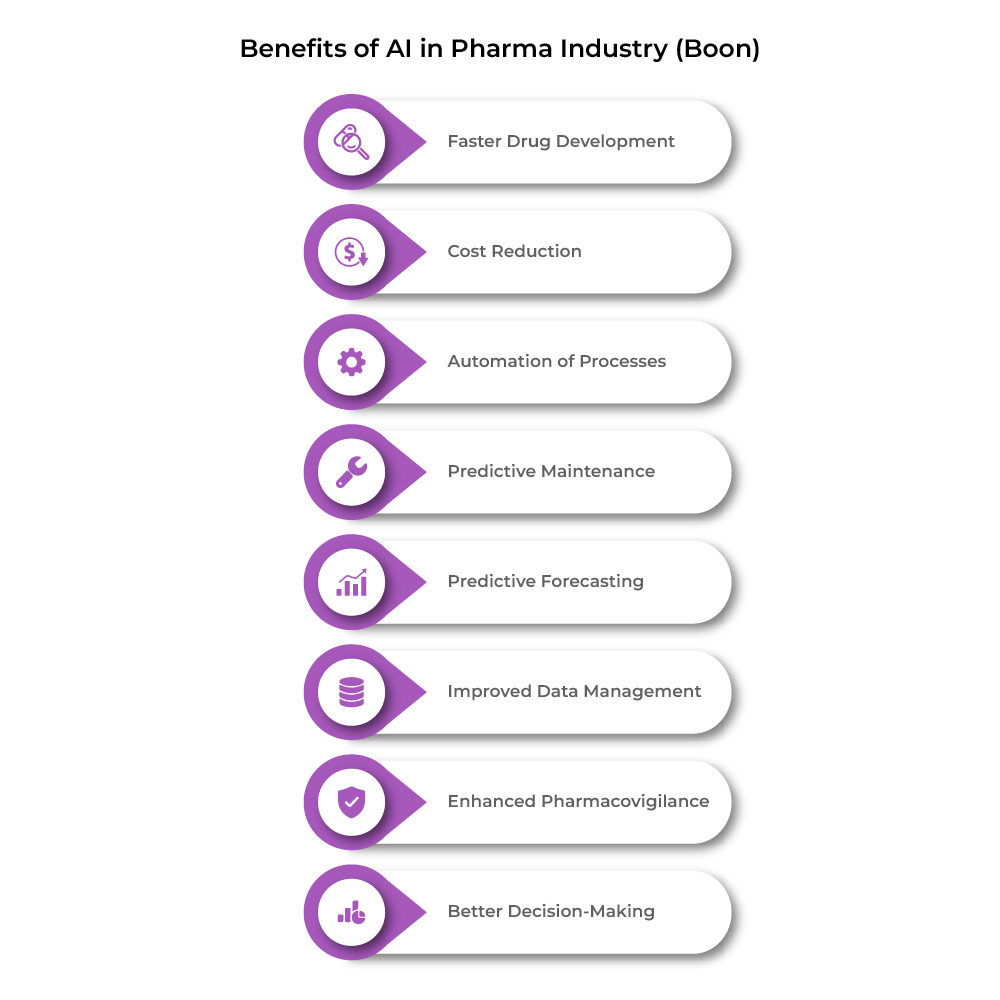
Benefits of AI in Pharma Industry (Boon)
Artificial Intelligence has brought major improvements to the pharmaceutical industry by increasing speed, efficiency, and accuracy in various processes. It helps simplify complex operations and supports better decision-making using data. Here are some key benefits of using AI in the Pharmaceutical industry:4
- Faster Drug Development: AI speeds up drug discovery by predicting compound behaviour and identifying potential side effects early. This reduces the time required to develop and approve New Drugs.
- Cost Reduction: AI helps reduce operational costs by automating routine tasks and improving resource management. It also minimizes human errors, which reduces wastage and additional expenses.
- Automation of Processes: AI automates repetitive tasks such as data analysis, quality checks, and documentation. This improves efficiency, consistency, and reduces manual workload in Pharmaceutical operations.
- Predictive Maintenance: AI monitors equipment performance and predicts failures before they occur. This helps avoid production delays and ensures continuous manufacturing without interruptions.
- Predictive Forecasting: AI can predict disease trends and seasonal outbreaks using data analysis. This helps companies plan inventory and manage supply chains more effectively.
- Improved Data Management: AI simplifies data handling by automating data collection, analysis, and validation. It reduces manual effort and improves accuracy in managing large datasets.
- Enhanced Pharmacovigilance: AI helps monitor drug safety by analysing real-time patient data and detecting adverse reactions quickly. This improves response time and ensures better patient safety.
- Better Decision-Making: AI provides data-driven insights that support faster and more accurate decisions. It helps companies understand market trends and patient needs more effectively.
Risks and Challenges of Using AI in the Pharma Industry (Bane)
AI is improving the Pharmaceutical industry, but it also creates several serious risks that cannot be ignored. These challenges affect data security, patient safety, and decision-making. Without proper control, AI can lead to harmful outcomes instead of benefits.
The major risks and challenges associated with the use of AI in the Pharmaceutical industry include:
- Data Privacy and Informed Consent: AI uses sensitive data like patient records, clinical trial data, and genetic information for training and analysis. This creates risks such as data breaches, misuse of information, and difficulty in ensuring proper patient consent.4
- Bias and Representation Issues: AI models can be trained on datasets that do not represent all populations, such as women or ethnic minorities. This can result in biased predictions and medicines that may not work equally well for all groups.1
- Lack of Transparency: AI models are often “black boxes,” meaning their decisions are not easily understood. This makes it difficult to trust the results and creates problems during regulatory approval.1,4
- Regulatory and Compliance Challenges: Pharmaceutical companies must follow strict laws like GDPR and HIPAA when handling patient data. Creating proper guidelines and validation processes for AI systems is still complex and evolving.4
- Safety and Misuse Risks: AI can generate incorrect predictions if not properly tested, affecting patient safety. It can also be misused to design harmful or toxic compounds, increasing biosecurity risks.1
- Integration and Infrastructure Issues: AI systems require advanced infrastructure and changes to existing workflows. Many companies face difficulties due to high costs and lack of proper systems.4
- Accountability and Ethical Concerns: It is often unclear who is responsible when AI systems cause harm due to multiple stakeholders. This creates ethical issues and reduces trust in AI-based decisions.1
Regulatory Role and Governance for Safe Use of AI in Pharma
Regulators are taking clear and structured steps to ensure the safe use of AI in Pharmaceutical manufacturing. These actions focus on managing governance challenges and applying strict regulatory controls within Good Manufacturing Practice (GMP) environments.
Some of the key regulatory actions taken to ensure the safe use of AI in the Pharmaceutical industry are:
- Regulators are updating existing rules and creating new standards because AI introduces challenges to ensuring quality, safety, and efficacy in drug development.
- They are strengthening data governance by addressing issues like patient consent, privacy, and limits on sharing proprietary datasets, while also supporting secure access systems and open data initiatives such as the Open Data Charter and UK Biobank.
- Authorities are examining intellectual property concerns, including patenting of AI algorithms and restricted access, which can limit innovation and reduce access for smaller companies and public health research.
- Regulators are also monitoring the private sector to prevent concentration of power, using measures like competition laws and impact assessments to avoid monopolies and “walled gardens”.
- Agencies such as the U.S. Food and Drug Administration, European Medicines Agency, and Medicines and Healthcare products Regulatory Agency are developing frameworks, pilot programs, and guidance to regulate AI use under GMP.
- A risk-based approach is used where high-risk AI applications require strict validation, detailed documentation (including training data and audit trails), continuous monitoring, and human oversight to ensure control and compliance.5
Conclusion
Artificial Intelligence is transforming the pharmaceutical industry by improving efficiency, accelerating Drug discovery, and enabling data-driven decision-making across the entire drug lifecycle. However, its benefits are accompanied by challenges such as data privacy risks, bias, and lack of transparency. Therefore, balanced regulatory frameworks and strong governance are essential to ensure the safe, ethical, and effective integration of AI in the Pharmaceutical industry.
Short Summary
- Artificial Intelligence (AI) is a major boon to the Pharmaceutical industry as it accelerates Drug discovery by analysing complex biological datasets and predicting Drug behaviour early.
- It improves efficiency and reduces costs by automating repetitive tasks such as data processing, manufacturing monitoring, and documentation.
- AI enhances decision-making by providing predictive insights for clinical trials, disease trends, and supply chain management.
- A key bane of AI is data privacy risk, as sensitive patient and clinical information can be exposed or misused during AI training.
- Another challenge is bias and lack of transparency, where AI models may produce unfair or unexplained outcomes affecting trust and accuracy.
- Regulatory frameworks are being developed globally to ensure safe AI use in pharma by enforcing validation, data governance, and human oversight.
References
1. Benefits and risks of using artificial intelligence for pharmaceutical development and delivery.
2. Bharat Jadhav DHG. Artificial Intelligence in the Pharmaceutical Industry: A Comprehensive Review. Published online November 8, 2025. doi:10.5281/ZENODO.17557545
3. Dr. M. J. Patil* KP. Artificial Intelligence in The Pharmaceutical Industry: Applications, Challenges, And Future Landscape. Published online March 20, 2026. doi:10.5281/ZENODO.19132956
4. Sadiku MNO, Adekunte PA, Sadiku JO. Artificial Intelligence in Pharmaceutical Industry.
5. Niazi SK. Regulatory Perspectives for AI/ML Implementation in Pharmaceutical GMP Environments. Pharmaceuticals (Basel). 2025;18(6):901. doi:10.3390/ph18060901
Recent Posts
How to Manufacture Class A & B Medical Devices in India: State FDA License Guide

A quick guide on the Class A & B Medical Device manufacturing license — covering State FDA rules, Form MD-3/MD-5, fees, and timelines for manufacturers. Every manufacturer entering India’s..
Importing Small Quantities of Cosmetics for R&D in India: NOC Requirements

A brief guide on Cosmetic import NOC India — covering when small quantity Cosmetic import for R&D testing bypasses full registration under Cosmetic rules 2020. Not every Cosmetic shipment into I..
The Cosmeceuticals Grey Zone: When a Cosmetic Claim Risks Becoming a Drug Claim

“Cosmeceutical” is a popular marketing word. It suggests something more powerful than an ordinary Cosmetic — a product that treats skin condition, not just improves appearance. The problem is th..
Need Help?
Submit your EnquiryOffice Locations
- Delhi
- Bangalore
- USA
- Singapore