
Table of Contents
Surfing the Tariff Tsunami: How do we Redefine India’s Place in Global Healthcare


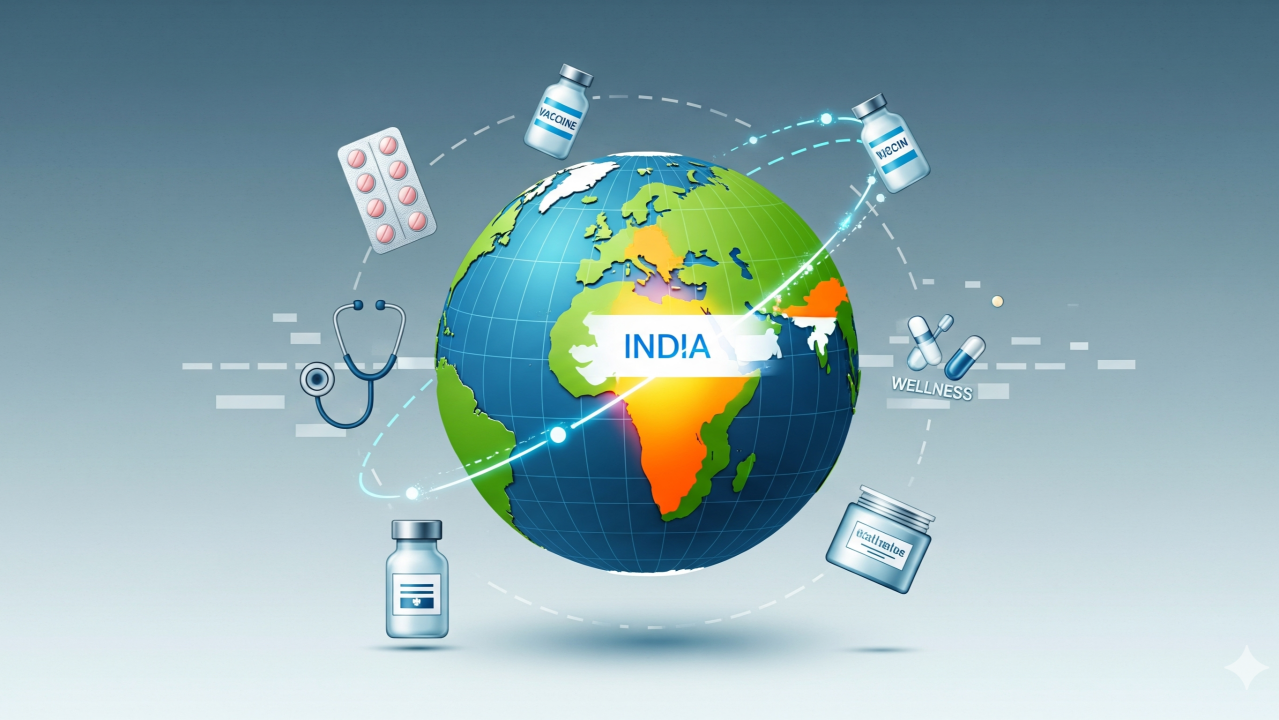
I still remember the phone calls that poured in late one April evening. Export managers, CEOs, and even small business owners were all trying to make sense of the sudden 26% tariff the US had just imposed on Indian health exports. The mood was tense but cautiously hopeful. Surely, this was temporary.
By August, that hope collapsed. The tariff wall had surged to 50%. Overnight, decades of trade equations were torn apart. Shipments of medical devices, supplements, cosmetics, and biologics suddenly looked unviable. Boardrooms turned into war rooms. And in the middle of this storm, India’s exporters had to ask themselves one question: Do we retreat, or do we reinvent?
Pharma and Vaccines: Temporary Relief, Strategic Risk
Pharmaceuticals and vaccines remain India’s strongest position. Pharmaceutical exports to the US are valued at about 10–11 billion dollars annually, much of it generics, which continue to flow tariff-free to US patients. Vaccines and many biologics too currently enjoy tariff exemption. The Serum Institute alone produces around 1.9 billion doses annually.
But every leader in this sector knows how fragile this exemption is. The Section 232 investigation underway in Washington could remove pharma’s shield by 2026, with some political voices even threatening tariffs as high as 150 to 250%. The message is clear: enjoy the breathing room, but prepare for impact.
The smartest players are already acting. Dr. Reddy’s, Cipla, and Aurobindo are expanding US footprints. Others are strengthening supply chain resilience and building partnerships that anchor Indian firms deeper into the American healthcare ecosystem. This is not defensive, it is strategic.
Medical Devices: From Export Pain to Domestic Opportunity
No sector has felt the blow harder than medical devices. A 50% tariff wipes out thin-margin products like diagnostics and surgical kits. Many exporters now face an impossible equation.
But here lies an overlooked truth. India imports 8.2 billion dollars worth of devices every year while exporting just 714 million dollars to the US.
Our domestic market, valued at 11–12 billion dollars, is 15 times the size of what we send across the ocean.
Instead of chasing shrinking margins in the US, device makers have a chance to pivot home. Even capturing 15% of India’s import substitution potential can replace lost American revenue without tariff burdens, currency risks, or compliance headaches. The crisis is not just a threat; it is an invitation to build India’s own medtech resilience.
Bottom line for us today is, the entire pharma industry needs to turn the tariff disadvantage into a domestic market advantage through import substitution
Nutraceuticals and Supplements: Reinventing and Diversifying
If any industry has been shaken to its core, it is supplements. For years, Indian exporters thrived by competing on price. A 50% tariff makes that model impossible.
The response cannot be cosmetic. Companies are now shifting towards Europe and Asia, where tariffs are lower (many EU and UK lines fall between 0–6.5% rather than 10 to 15%). Others are exploring “friendship manufacturing” in low-tariff countries to bypass barriers.
Some are even reclassifying products under pharmaceutical categories to access exemptions.
Facing high tariff exposure in the 105–135 billion dollar US market, Indian cosmetics are at a severe competitive disadvantage compared to rivals like the EU (where tariffs are typically 0 — 6.5%) and the UK (many categories at 0%). This is unlike the pharmaceutical industry, which enjoys tariff exemptions. A strategic pivot is therefore essential. The immediate focus must shift to redirecting efforts toward the 28 billion dollar domestic market, which is growing steadily, and expanding into more favorable markets like the EU. The core opportunity lies in leveraging India’s rich heritage to build a global leadership position in natural beauty, especially by utilizing Ayurvedic ingredients, which may offer tariff exemptions. This approach allows the industry to sidestep an inaccessible US market while capitalizing on domestic growth and building a new competitive advantage.
Back home, India’s domestic wellness market, worth 156 billion dollars, is a goldmine waiting to be tapped. By building direct-to-consumer brands rooted in Ayurveda and backed by research, India can reduce US dependence while rising as a global wellness innovator.
Cosmetics: Finding Identity Beyond Cost
For cosmetics, the tariffs have split the industry in two. The mass-market game has collapsed. But Ayurvedic and natural brands are finding resilience. By repositioning themselves as heritage-driven, sustainable, and premium, they are turning crisis into identity. Some are even pivoting from exporting finished products to supplying active ingredients, a quieter but lucrative play.
Facing a prohibitive 50% total tariff in the $105 billion US market, Indian cosmetics are at a severe competitive disadvantage compared to rivals like the EU and the UK. This is unlike the pharmaceutical industry, which enjoys tariff exemptions. A strategic pivot is therefore essential. The immediate focus must shift to redirecting efforts toward the $28B domestic market, which is growing at a healthy 5.6% CAGR, and expanding into more favorable markets like the EU, where tariffs are a more manageable 20%. The core opportunity lies in leveraging India’s rich heritage to build a global leadership position in natural beauty, especially by utilizing Ayurvedic ingredients, which may offer tariff exemptions. This approach allows the industry to sidestep an inaccessible US market while capitalizing on domestic growth and building a new competitive advantage.
What tariffs are forced is a deeper question of self-definition: Are we exporters of low-cost creams, or storytellers of beauty rooted in culture?
Biologics: Innovation at a Crossroads
Biologics face perhaps the most layered impact. Tariffs reach from APIs to clinical trial samples, threatening to slow innovation. Yet collaborations are flourishing Indian firms are forming joint research ventures, contract manufacturing tie-ups, and technology transfers with US companies.
The real play here is not just protecting today’s margins but securing tomorrow’s innovation pipelines. By embedding themselves in global biotech partnerships, Indian players are ensuring they remain indispensable in the world of advanced therapies.
A 30 Billion Dollar Turning Point
More than 30 billion dollars of Indian health exports are exposed to this tariff shock. Over half our merchandise shipments to the US are now entangled in policy battles.
It feels like a crisis, but I believe it is a turning point. Tariffs are pushing us to move beyond cost competitiveness and embrace value competitiveness. They are forcing us to diversify, innovate, and rethink what it means to be a global health partner.
From Survival to Strategy: The CEO’s Playbook
- Diversify markets. Europe, Latin America, and ASEAN must become core growth engines, not fallback options.
- Build resilience at home. Capture India’s own 11 billion dollar medtech market and 43 billion dollar wellness market instead of chasing shrinking margins abroad.
- Invest in regulatory excellence. Faster CDSCO approvals can become India’s global trust badge.
- Strengthen global presence. US assembly lines, “friendship manufacturing,” and partnerships reduce vulnerability.
- Redefine value. Authenticity, research, and sustainability must replace price as our story.
- Create war rooms. Every exporter needs live intelligence on global trade winds, not just quarterly reviews.
Conclusion: Reimagining India’s Role
Tariffs may look like barriers, but they are in fact catalysts. They are forcing us to evolve from low-cost exporters to high-value innovators, from commodity suppliers to trusted partners, from chasing margins abroad to building markets at home.
The years ahead will not be remembered as the time tariffs crippled Indian healthcare exports. They will be remembered as the moment India reinvented them, a moment when resilience met reinvention, and when India redefined its place in the global health economy.
Recent Posts
Importing Small Quantities of Cosmetics for R&D in India: NOC Requirements

A brief guide on Cosmetic import NOC India — covering when small quantity Cosmetic import for R&D testing bypasses full registration under Cosmetic rules 2020. Not every Cosmetic shipment into I..
The Cosmeceuticals Grey Zone: When a Cosmetic Claim Risks Becoming a Drug Claim

“Cosmeceutical” is a popular marketing word. It suggests something more powerful than an ordinary Cosmetic — a product that treats skin condition, not just improves appearance. The problem is th..
Ingredient Safety Dossiers: Building a Defensible Package for Novel Actives

Companies developing Cosmetics with new or unusual active ingredients face a higher regulatory bar in India than those using well-established formulations. Understanding what “new” means under the..
Need Help?
Submit your EnquiryOffice Locations
- Delhi
- Bangalore
- USA
- Singapore